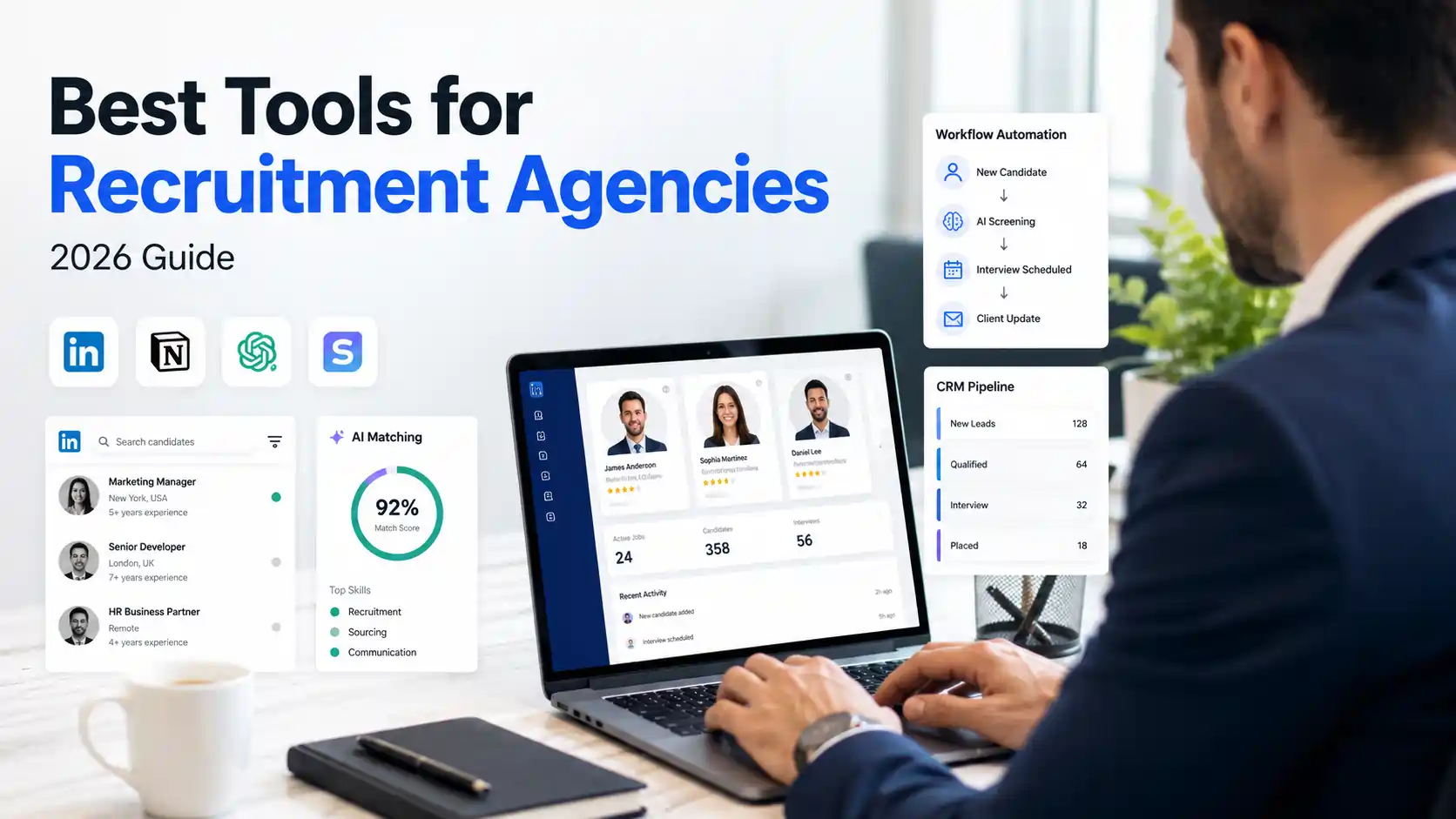
| The best tools for recruitment agencies in 2026 combine LinkedIn Recruiter for direct candidate access, Sales Navigator-style search precision, AI sourcing tools for faster shortlisting, and automation platforms like n8n to handle repetitive outreach and follow-ups. Together, these four categories cut sourcing time significantly without adding headcount. |
Every recruitment agency runs into the same wall: too many open roles, not enough hours to source, screen, and reach out to candidates properly. This is exactly where the right tool stack changes the math.
A scattered set of subscriptions doesn’t help. What actually moves the needle is a focused stack – LinkedIn Recruiter for sourcing, Sales Navigator-style search precision, AI tools that shortlist faster, and automation that handles outreach without a recruiter typing the same message fifty times. That’s the practical shape of the best tools for recruitment agencies in 2026, and this guide breaks it down end to end.
This isn’t theory. It’s built around how agencies actually fill roles – under deadline pressure, across multiple open positions, with small teams doing the sourcing, screening, and outreach all at once.
Key Takeaways
● A focused stack – LinkedIn Recruiter, Sales Navigator, AI sourcing, and n8n automation – beats a scattered subscription list for most agencies.
● Agencies that buy LinkedIn Recruiter Lite for agency teams get direct InMail access and pipeline tools most small-to-mid agencies actually need.
● Choosing between LinkedIn’s two search-and-outreach platforms isn’t an either-or call – agencies often use both for different stages of the funnel.
● AI-assisted shortlisting tools cut review time significantly by pre-filtering candidates against role criteria.
● Connecting sourcing, CRM, and outreach into one workflow removes three separate manual steps agencies used to handle by hand.
● Agencies that automate their follow-up sequences remove the repetitive outreach work that eats a recruiter’s day.
🔥 LinkedIn Premium Business Plan 12 Months
Original Price ₹23,000 • Get it ₹8XXX
🤖 Gemini AI Advanced Pro Plan
Original Price ₹19,500 • Get it ₹8XXX
💼 LinkedIn Sales Navigator Core
Original Price ₹80,000 • Get it ₹2XXXX
🎨 Canva Pro Lifetime Access
Original Price ₹3,999 • Get it ₹4XX
📚 Coursera Plus Annual Plan
Original Price ₹33,000 • Get it ₹2XXX
✨ Adobe Creative Cloud All Apps
Original Price ₹59,000 • Get it ₹4XXX
What Is a Recruitment Agency Tool Stack (and Why It Matters in 2026)
A recruitment agency tool stack is the connected set of platforms an agency uses to find candidates, filter them against role requirements, reach out, and track the pipeline through to placement. For most agencies, this means a sourcing platform, a search and filtering tool, an AI-assisted shortlisting layer, and an automation connector.
Client expectations have shifted the same way they have in marketing. Companies hiring through an agency in 2026 expect faster shortlists, weekly pipeline updates, and consistent outreach – without paying for a bigger recruiting team on the agency’s side. Without some automation, agencies either burn out their recruiters or start missing deadlines on open roles.
A good stack doesn’t automate judgment calls. It automates the repetitive parts – searching by criteria, sending the first outreach message, logging responses – while keeping interviews, candidate evaluation, and client conversations with actual recruiters. This is the thinking behind every recommendation on the best tools for recruitment agencies list below.
It’s worth being clear about what this stack doesn’t do. It won’t fix a weak employer value proposition, a client with unrealistic hiring criteria, or a recruiter who hasn’t built rapport with candidates. Tools speed up the mechanical parts of sourcing and outreach – they don’t replace the relationship-building that actually gets a candidate to say yes to an offer.
Also Read – Zapier vs Make vs n8n: Which Workflow Automation Software Is Best in 2026?
What Are the Best Tools for Recruitment Agencies in 2026?
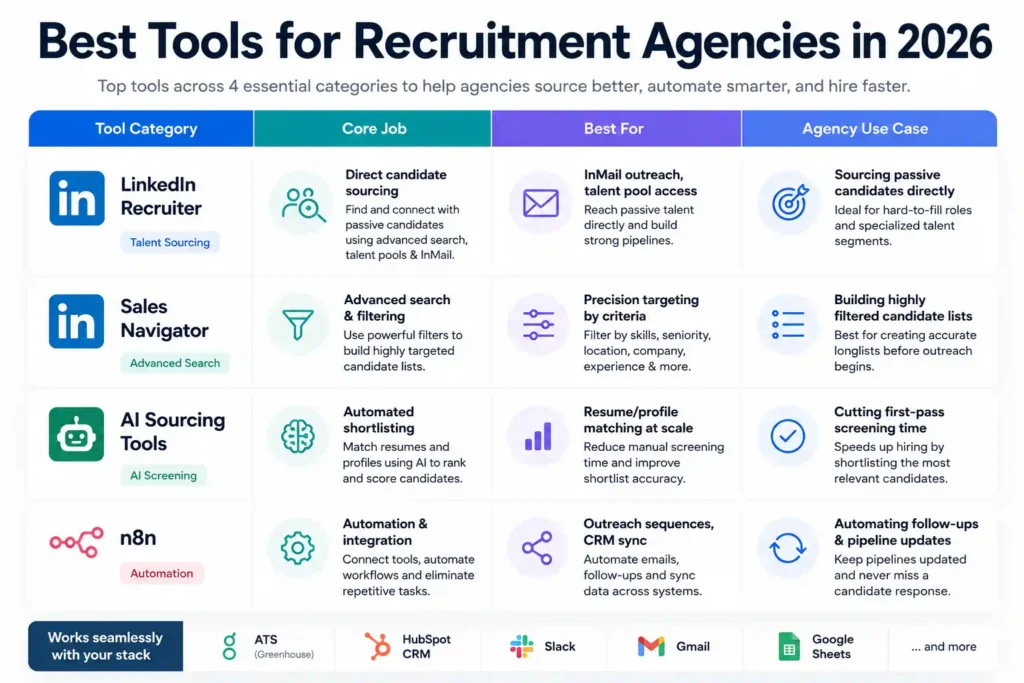
Most of the best tools for recruitment agencies fall into four categories, each solving a different part of the hiring funnel rather than overlapping with each other.
| Tool Category | Core Job | Best For | Agency Use Case |
| LinkedIn Recruiter | Direct candidate sourcing | InMail outreach, talent pool access | Sourcing passive candidates directly |
| Sales Navigator | Advanced search & filtering | Precision targeting by criteria | Building highly filtered candidate lists |
| AI Sourcing Tools | Automated shortlisting | Resume/profile matching at scale | Cutting first-pass screening time |
| n8n | Automation & integration | Outreach sequences, CRM sync | Automating follow-ups and pipeline updates |
| Did You Know?Recruitment agencies that automate at least the outreach follow-up step typically see faster response rates from candidates, simply because messages go out consistently instead of whenever a recruiter finds time between calls. |
No single tool here replaces a recruiter’s judgment. Each one removes a specific bottleneck in the pipeline – and the combination is what actually changes turnaround time on open roles.
🔥 LinkedIn Premium Business Plan 12 Months
Original Price ₹23,000 • Get it ₹8XXX
🤖 Gemini AI Advanced Pro Plan
Original Price ₹19,500 • Get it ₹8XXX
💼 LinkedIn Sales Navigator Core
Original Price ₹80,000 • Get it ₹2XXXX
🎨 Canva Pro Lifetime Access
Original Price ₹3,999 • Get it ₹4XX
📚 Coursera Plus Annual Plan
Original Price ₹33,000 • Get it ₹2XXX
✨ Adobe Creative Cloud All Apps
Original Price ₹59,000 • Get it ₹4XXX
How Would an Agency Fill 10 Roles in a Month Using This Stack?
Picture a mid-sized recruitment agency with three recruiters, ten open roles across two clients, and a mandate to fill most of them within four weeks. Without a structured stack, each recruiter sources manually, drafts individual outreach messages, and updates a shared spreadsheet whenever they remember to.
Now layer in the stack described in this guide. Sales Navigator builds a filtered longlist for each role in under an hour instead of a full afternoon of manual searching. LinkedIn Recruiter handles InMail outreach with built-in pipeline tags, so no recruiter loses track of who’s already been contacted. An AI sourcing tool pre-ranks candidates by fit, cutting the first-pass review from days to hours. n8n handles the follow-up sequence automatically, freeing recruiters to focus on interviews and client calls instead of chasing replies.
The difference isn’t magic – it’s removing five or six manual handoffs per candidate and letting the recruiter step in only where judgment actually matters: screening calls, shortlist presentation, and closing conversations with the client.
Agencies that run this kind of structured process consistently report shorter time-to-shortlist and fewer candidates falling through the cracks between sourcing and interview, simply because nothing depends on a recruiter remembering to follow up manually.
Why Use LinkedIn Recruiter for Agencies?
LinkedIn Recruiter consistently ranks among the best tools for recruitment agencies because it combines direct sourcing access with pipeline tracking in one place, rather than requiring separate tools for search and candidate management.
Agencies that buy LinkedIn Recruiter Lite for agency teams typically do so because it unlocks direct InMail credits, expanded search filters, and candidate pipeline tracking that a standard LinkedIn account doesn’t offer. For agencies filling multiple roles weekly, this access pays for itself in reduced sourcing time.
How Recruitment Agencies Use LinkedIn Recruiter
Most agencies use LinkedIn Recruiter for three core tasks: building talent pools for recurring role types, sending InMails to passive candidates who aren’t actively job hunting, and tracking candidate status across multiple open requisitions without losing context between roles.
● Talent pool creation for roles the agency fills repeatedly (e.g., recurring tech or sales positions)
● InMail outreach to passive candidates not visible through standard search
● Pipeline tracking tags to separate candidates by role, client, and stage
● Saved search alerts for new candidates matching a specific role profile
Who should buy Recruiter Lite: Agencies filling 5+ roles a month where sourcing volume justifies the InMail credit cost. Who should hold off: Agencies running fewer than 2-3 active searches at a time may get enough reach from a standard account paired with referrals.
🔥 LinkedIn Premium Business Plan 12 Months
Original Price ₹23,000 • Get it ₹8XXX
🤖 Gemini AI Advanced Pro Plan
Original Price ₹19,500 • Get it ₹8XXX
💼 LinkedIn Sales Navigator Core
Original Price ₹80,000 • Get it ₹2XXXX
🎨 Canva Pro Lifetime Access
Original Price ₹3,999 • Get it ₹4XX
📚 Coursera Plus Annual Plan
Original Price ₹33,000 • Get it ₹2XXX
✨ Adobe Creative Cloud All Apps
Original Price ₹59,000 • Get it ₹4XXX
Which Is Better: LinkedIn Recruiter vs Sales Navigator for Hiring?
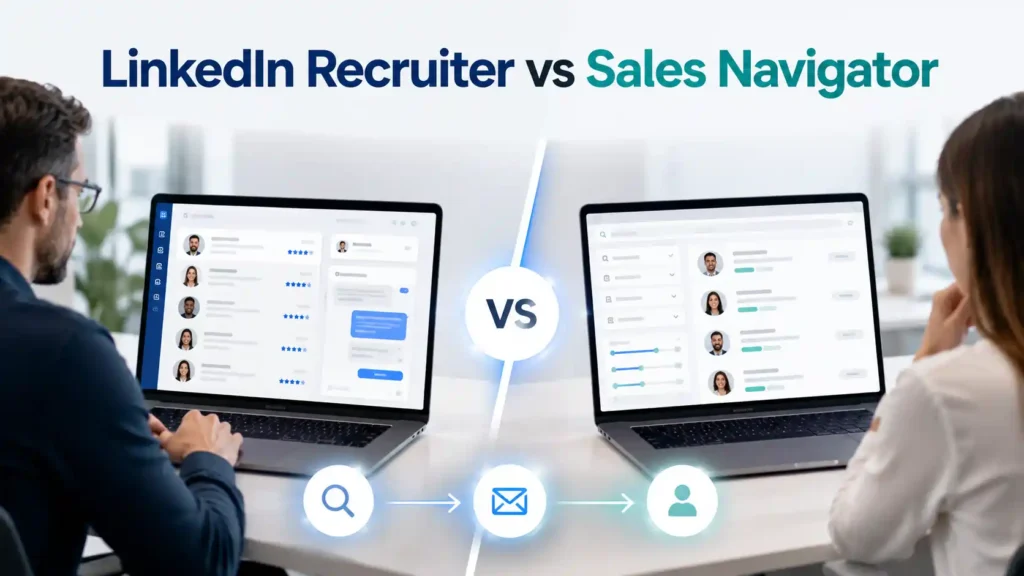
The LinkedIn Recruiter vs Sales Navigator for hiring debate comes up in almost every agency evaluating tool spend, and the honest answer is that they solve different problems. Recruiter is built for direct candidate outreach with InMail access, while Sales Navigator’s filtering depth is often better for building precise longlists before outreach even starts.
| Factor | LinkedIn Recruiter | Sales Navigator |
| Built for recruiting | Yes | No (adapted by recruiters) |
| InMail credits included | Yes | Limited |
| Advanced search filters | Strong | Stronger |
| Candidate pipeline tracking | Native | Not built for it |
| Cost efficiency for high-volume sourcing | Better | Moderate |
Many agencies end up running both – Sales Navigator for the initial filtered search, then Recruiter for InMail outreach and pipeline tracking once a longlist is built.
Also Read – Apollo.io Review 2026: Is This the Best B2B Lead Generation Tool for Sales Teams?
What Are the Best AI Sourcing Tools for Recruiters?
The best AI sourcing tools for recruiters work by scanning large candidate pools against role criteria and surfacing the closest matches first, cutting the manual profile-by-profile review that eats hours on every open search.
These tools don’t replace the recruiter’s evaluation – they narrow a pool of hundreds down to a shortlist a human can actually review in detail. The value is speed on the first pass, not final decision-making.
● Skill and keyword matching against job descriptions at scale
● Ranking candidates by relevance instead of manual sorting
● Flagging profile gaps (missing experience, location mismatch) before outreach
● Reducing time spent on candidates who were never a realistic fit
| Did You Know?AI sourcing tools work best when the job description criteria are specific. Vague or overly broad requirements return wide, low-quality shortlists no matter how good the underlying matching model is – the input quality still drives the output quality. |
Which Candidate Sourcing Automation Tools 2026 Should Agencies Use?
candidate sourcing automation tools 2026 increasingly connect sourcing, CRM, and outreach into a single workflow instead of three disconnected manual steps that a recruiter has to bridge by hand every time.
The shift agencies are making isn’t toward a single all-in-one platform – it’s toward connecting the specialized tools they already use through automation, so data moves between them without manual re-entry.
● New candidate profiles auto-tagged into a CRM as they’re sourced
● Outreach status synced back to the pipeline automatically
● Interview scheduling triggered once a candidate responds positively
● Client-facing pipeline reports generated on a schedule instead of manually
How Do You Automate Candidate Outreach with n8n?
Agencies automate candidate outreach with n8n by connecting LinkedIn exports, email platforms, and CRMs through scheduled workflows that send follow-ups and log responses without a recruiter manually tracking each conversation thread.
This is the piece that saves the most recruiter hours once a search hits real volume. Manually following up with 40-50 candidates across multiple roles is where sourcing time disappears fastest.
What Does a Typical n8n Outreach Workflow Look Like?
- Trigger fires when a new candidate is added to a sourcing list
- Sends an initial outreach message through email or LinkedIn export
- Waits a set number of days, then sends a follow-up if there’s no response
- Logs every response into the CRM pipeline automatically
- Alerts the recruiter when a candidate replies positively
| Did You Know?n8n is workflow-based rather than pay-per-contact, which is why agencies running high sourcing volume often prefer it over per-message automation pricing once outreach volume grows past a few hundred candidates a month. |
Also Read – LinkedIn Sales Navigator vs Apollo: Which Tool Works Better?
How to Automate Candidate Sourcing Process
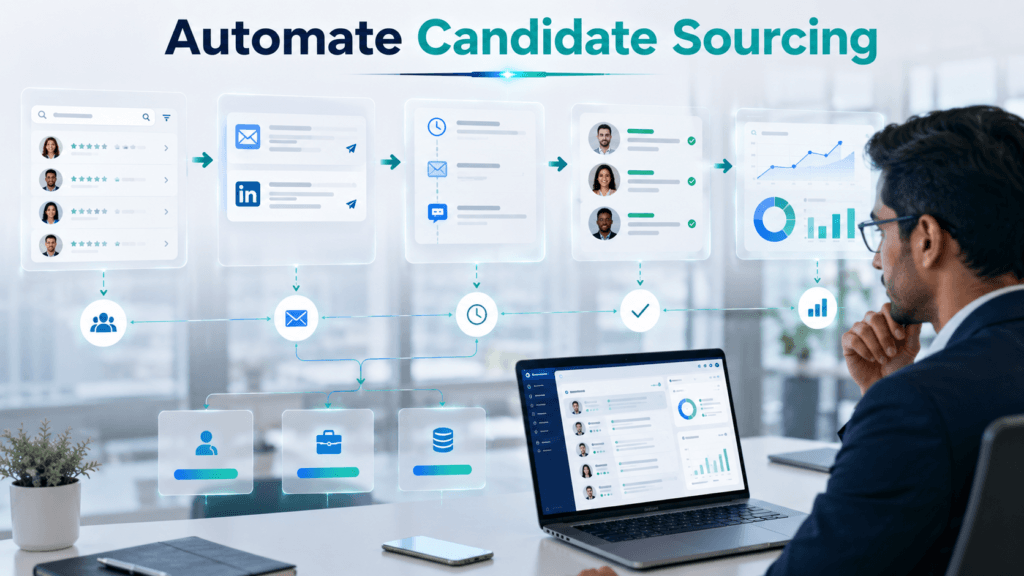
Learning to streamline this workflow starts with mapping which steps are repetitive and low-judgment – search execution, first-touch outreach, follow-up sequencing – versus which steps genuinely need a recruiter’s evaluation, like interview screening and client presentation.
Step 1: Audit the sourcing steps your team repeats manually for every role.
Step 2: Automate the search-to-outreach handoff first, since it’s usually the biggest time sink.
Step 3: Set follow-up sequences with fixed intervals instead of ad hoc reminders.
Step 4: Route positive responses straight to the recruiter’s queue instead of a shared inbox.
Step 5: Review automation performance monthly and adjust messaging that isn’t converting.
What Tools Do International Recruitment Agencies Use
For cross-border hiring, the toolset usually comes down to the same core stack – LinkedIn Recruiter, Sales Navigator, AI sourcing, and automation – configured for multiple time zones, languages, and regional compliance requirements rather than a completely different set of platforms.
The main difference for international agencies is workflow structure, not tooling. Automated outreach sequences need to account for time zone-appropriate send windows, and candidate data handling needs to respect regional data protection rules like GDPR for EU-facing searches.
How to Speed Up Time to Hire with Automation Tools
Speeding up hiring comes down to removing the delay points between each stage of the funnel – sourcing to outreach, outreach to response, response to interview scheduling – since most delay isn’t sourcing itself, it’s the gaps between steps.
● Automated first-touch outreach removes the delay between sourcing and first contact
● Scheduled follow-ups prevent candidates going cold from being forgotten
● Auto-scheduling tools remove the back-and-forth email chain for interview times
● Automated status updates keep clients informed without manual reporting delays
What Is the Best Workflow for Sourcing Candidates on LinkedIn?
The most effective approach combines Sales Navigator for building a precisely filtered longlist, LinkedIn Recruiter for InMail outreach and pipeline tracking, and an automation layer to handle follow-ups – run in that order rather than sourcing and messaging simultaneously.
● Build the longlist first using filtered search criteria, not open-ended browsing
● Move only qualified profiles into Recruiter for outreach
● Send personalized first-touch messages, automate the follow-up sequence
● Track every response in a shared pipeline view, not individual inboxes
What Common Mistakes Do Agencies Make With Recruitment Tools?
Even with access to the best tools for recruitment agencies, most failures come down to implementation, not tool choice.
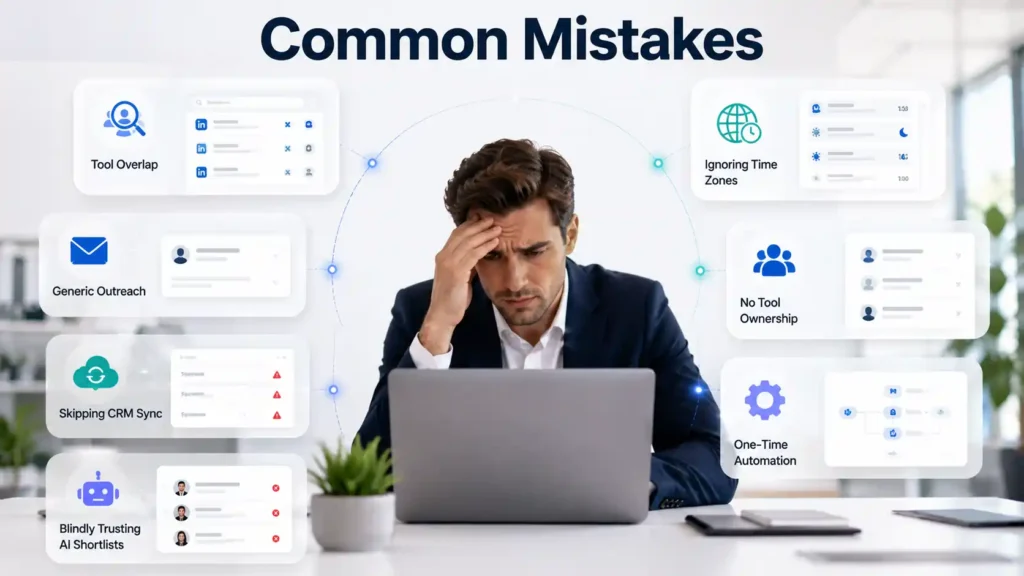
Buying LinkedIn Recruiter and Sales Navigator without a clear division of use. Teams that don’t define which tool handles which stage end up duplicating search work across both platforms.
Sending generic outreach at scale. Automating a bad message just sends the bad message faster and burns candidate goodwill across a bigger list.
Skipping the CRM sync step. Without automated logging, recruiters lose track of who’s already been contacted, leading to duplicate or conflicting outreach.
Over-relying on AI shortlists without spot-checking. AI sourcing tools narrow the pool well, but skipping a manual sanity check occasionally lets a strong candidate get filtered out on a technicality.
Ignoring time zone settings in automated sequences. For international searches, outreach that lands at 3 AM local time gets ignored regardless of message quality.
Not defining who owns each tool. When three recruiters have access to the same Recruiter seat without clear ownership of specific searches, duplicate outreach and conflicting candidate notes become common.
Treating automation as a one-time setup. Message templates, follow-up timing, and AI filter criteria all need periodic review – what worked for a role six months ago often underperforms as candidate behavior and market conditions shift.
Also Read – How to Use LinkedIn Sales Navigator: The Definitive Guide for 2026
Expert Tips
A few habits separate agencies that actually benefit from the best tools for recruitment agencies from those that just pay for extra software.
● Set a fixed follow-up cadence (e.g., day 1, day 4, day 8) rather than ad hoc reminders – consistency outperforms urgency in candidate outreach.
● Keep one shared pipeline view per client so no two recruiters accidentally contact the same candidate.
● Review AI shortlist criteria every few searches – role requirements drift, and stale filters return weaker matches over time.
● Automate the boring steps first (follow-ups, status logging) before automating anything client-facing.
How Much Should Agencies Budget for a Recruitment Tool Stack?
Cost is usually the first objection agencies raise before adopting a fuller stack, and it’s a fair one. LinkedIn Recruiter seats, Sales Navigator licenses, AI sourcing subscriptions, and automation platforms all carry separate price tags, and per-seat costs add up quickly across a growing team.
The way most agencies make the math work is by tying tool cost to search volume rather than buying every seat upfront. A solo recruiter running two or three searches a month rarely needs a full Recruiter seat. An agency running fifteen concurrent searches across multiple clients almost always saves more in recruiter hours than it spends on licensing.
A reasonable approach: start with Sales Navigator and manual outreach to validate that a role type is worth heavier investment, then add Recruiter and automation once search volume for that role category becomes consistent month over month. This avoids paying for infrastructure that outpaces actual hiring demand.
What Should You Check Before Adopting a New Recruitment Tool?
● Does this tool solve a real bottleneck in our current sourcing process?
● Does it fit into our existing stack, or does it duplicate something we already have among the best tools for recruitment agencies we’re using?
● Can it integrate with our CRM through automation, or does it require manual data entry?
● Is there a clear team member responsible for managing it?
● Have we set a review point to check if it’s actually saving time after 60-90 days?
What Are the Pros and Cons of Building a Recruitment Agency Tool Stack?
| Pros | Cons |
| Cuts sourcing and outreach time significantly | Requires upfront setup and workflow mapping |
| Speeds up time-to-hire across open roles | Per-seat and per-credit costs can add up quickly |
| Keeps pipeline data consistent across recruiters | Automation on a messy process just breaks faster |
| Scales search volume without proportional headcount growth | Needs periodic review to avoid stale filters and messaging |
| Improves candidate response consistency | Team needs training on tool handoffs and ownership |
Also Read – What Is LinkedIn Sales Navigator? The Ultimate Tool for B2B Leads
Conclusion
The best tools for recruitment agencies in 2026 aren’t about subscribing to everything available – they’re about a focused stack that removes real bottlenecks: LinkedIn Recruiter and Sales Navigator for sourcing and outreach, AI tools for faster shortlisting, and n8n for automating the follow-up work that quietly eats a recruiter’s week.
None of this replaces a recruiter’s judgment on who’s actually the right fit for a role. It just clears out the repetitive work between sourcing and interview, so more of the week goes toward the conversations that actually fill roles. Among the best tools for recruitment agencies, start with the bottleneck costing you the most hours, automate that one properly, and build outward.
Get This Entire Stack Through One Trusted Source
LinkedIn Recruiter, Sales Navigator, AI sourcing tools, and n8n-connected automation apps are all available through PremiumToolsHub, along with a much wider range of AI, business, and productivity tools your recruitment agency will need as you scale.
| Why Agencies Switch to PremiumToolsHub● Proper billing invoice with every purchase – every transaction is clean, documented, and professional, so your agency’s books stay in order with zero ambiguity about what you paid and what you received.● Real human support on WhatsApp, 9 AM to 12 AM IST – no bots, no ticket queues, no waiting days for a reply. A real person answers your message and resolves it, usually within a few hours, sometimes minutes.● 100% legitimate access through proper licensing – every tool is provisioned through official family plans, team workspaces, corporate licensing tiers, and authorized reseller programs. No cracked software, no stolen accounts, no risk to your agency’s reputation.● Way more than just recruiting tools – PremiumToolsHub covers AI and productivity, design and creative, business and career, and learning tools, all backed by the same support and warranty. Message PremiumToolsHub on WhatsApp to set up your agency’s recruitment stack |
Frequently Asked Questions
What tools do recruitment agencies use to find candidates?
Most agencies use LinkedIn Recruiter and Sales Navigator for direct sourcing, paired with AI sourcing tools to shortlist faster and automation platforms like n8n to handle outreach follow-ups and pipeline updates.
Is LinkedIn Recruiter better than Sales Navigator for hiring?
It depends on the stage. Recruiter is built specifically for outreach with InMail credits and pipeline tracking, while Sales Navigator often has deeper filtering for building a precise longlist before outreach starts. Many agencies use both.
How can AI help recruitment agencies source candidates faster?
AI sourcing tools scan large candidate pools against role criteria and rank the closest matches first, cutting the manual profile-by-profile review that normally eats hours on every open search.
What is the best software for recruitment agencies in 2026?
There isn’t one single best tool – the best tools for recruitment agencies in 2026 form a stack: LinkedIn Recruiter or Sales Navigator for sourcing, an AI tool for shortlisting, and an automation platform like n8n for outreach and pipeline updates.
How do recruiters automate candidate outreach?
Recruiters typically use automation tools like n8n to trigger outreach messages when a candidate is added to a sourcing list, schedule follow-ups at fixed intervals, and log every response automatically into their CRM.