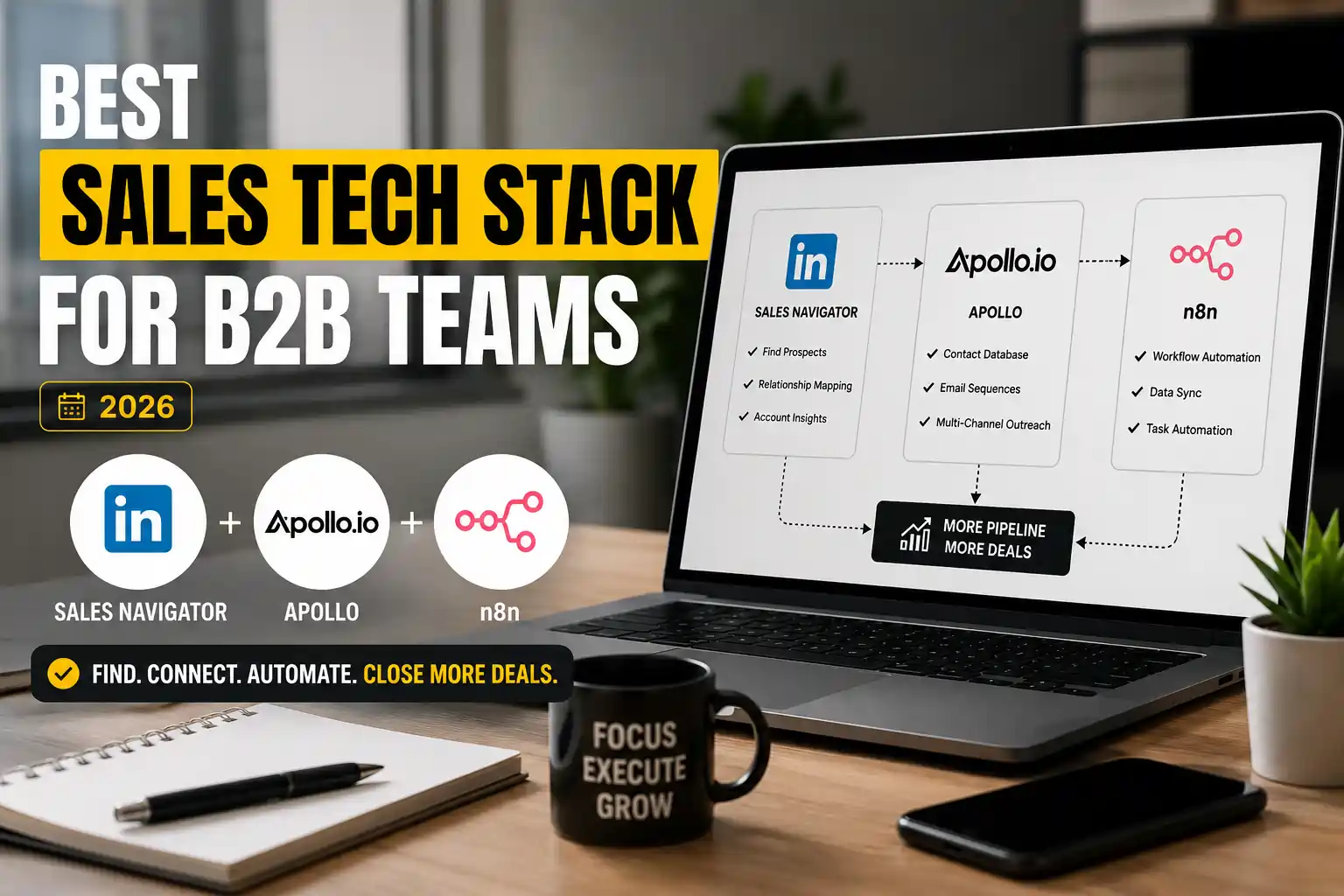
The best sales tech stack for B2B teams in 2026 combines three layers: a live data source to find the right prospects, an outreach engine to actually reach them, and an automation layer that connects the two without manual work. For most growing B2B teams, that means LinkedIn Sales Navigator for relationship-driven prospecting, Apollo.io for contact data and email sequencing, and n8n to automate the handoff between them. This guide breaks down what each tool does, how they work together, and how to build the best sales tech stack for B2B teams step by step – even if you’re starting from zero.
What Is a B2B Sales Tech Stack – And Why Does It Matter in 2026?
If you ask ten sales leaders what their best sales tech stack for B2B teams looks like, you will get ten different answers – and most of them will be wrong, not because the tools are bad, but because the tools are not talking to each other. A sales tech stack is simply the combination of platforms a team uses to find prospects, reach out to them, and move them through a pipeline. In 2026, the best B2B sales tools 2026 are not judged by how many features they pack in, but by how cleanly they connect. A rep who spends fifteen minutes copying a lead from one tab to another is not selling – they are doing data entry. That is the real cost of a disconnected stack, and it is exactly what this guide solves.
| Did You Know? The average B2B sales rep loses close to two hours a day switching between disconnected tools – time that could otherwise go into actual conversations with prospects. |
Also Read – How to Use LinkedIn Sales Navigator: The Definitive Guide for 2026
🔥 LinkedIn Premium Business Plan 12 Months
Original Price ₹23,000 • Get it ₹8XXX
🤖 Gemini AI Advanced Pro Plan
Original Price ₹19,500 • Get it ₹8XXX
💼 LinkedIn Sales Navigator Core
Original Price ₹80,000 • Get it ₹2XXXX
🎨 Canva Pro Lifetime Access
Original Price ₹3,999 • Get it ₹4XX
📚 Coursera Plus Annual Plan
Original Price ₹33,000 • Get it ₹2XXX
✨ Adobe Creative Cloud All Apps
Original Price ₹59,000 • Get it ₹4XXX
Who Needs This Sales Tech Stack? (Startups, Agencies & Growing Sales Teams)
This particular combination works best for small and mid-sized B2B teams – agencies, recruitment firms, SaaS startups, and lean sales pods that cannot afford a fifteen-tool enterprise setup but still need enterprise-level results. Among the best B2B sales tools 2026 has to offer, this combination is the one that consistently shows up in growing teams’ stacks, because it solves prospecting and outreach without forcing a five-figure annual commitment. If you are a solo founder doing outbound yourself, a two-person sales team at a growing agency, or a recruitment business sourcing candidates and clients at the same time, this stack is built for you. It is less useful if you are running a 200-person enterprise sales org with dedicated RevOps – at that scale, you likely need additional layers like dedicated CRM orchestration and conversation intelligence. But for everyone scaling from zero to a repeatable sales motion, this is the best sales tech stack for B2B teams you can realistically set up in a week.
Why LinkedIn Sales Navigator Is the Foundation of Relationship-Based Selling
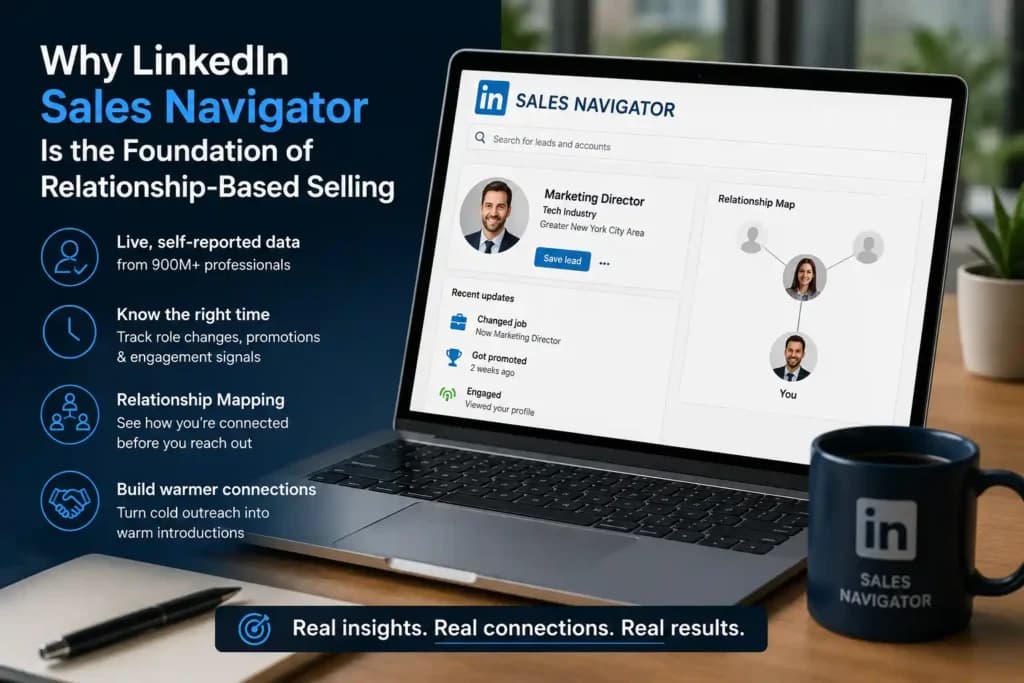
LinkedIn Sales Navigator works because it gives you access to live, self-reported data from over 900 million professionals – information that changes the moment someone updates their job title or company. Why does this matter? Because relationship-driven selling depends on timing: knowing the moment a prospect changes roles, gets promoted, or shows engagement signals lets you reach out when they are most receptive, not three months too late. Sales Navigator’s relationship mapping shows you how you are already connected to a target account through your network, which turns a cold message into a warm introduction. Teams that want to buy LinkedIn Sales Navigator for sales team use typically fall into one category: they are selling into mid-to-large accounts where deal size justifies a slower, trust-based approach. If your business depends on warm relationships rather than high-volume blasts, this is the tool that should anchor your stack.
🔥 LinkedIn Premium Business Plan 12 Months
Original Price ₹23,000 • Get it ₹8XXX
🤖 Gemini AI Advanced Pro Plan
Original Price ₹19,500 • Get it ₹8XXX
💼 LinkedIn Sales Navigator Core
Original Price ₹80,000 • Get it ₹2XXXX
🎨 Canva Pro Lifetime Access
Original Price ₹3,999 • Get it ₹4XX
📚 Coursera Plus Annual Plan
Original Price ₹33,000 • Get it ₹2XXX
✨ Adobe Creative Cloud All Apps
Original Price ₹59,000 • Get it ₹4XXX
What Is Apollo.io and How It Solves the Outreach Gap
Apollo.io takes the opposite approach. Instead of relying on a single network, it gives you direct access to a massive B2B contact database along with built-in email sequencing – meaning you can find a lead and start emailing them within the same platform, without switching tools. This matters because Sales Navigator has no native email outreach; it is brilliant for finding the right person but leaves you stranded once you need to actually contact them at scale.
That is exactly the gap an Apollo.io alternative for lead generation conversation usually starts with – teams realize they need a database tool that also handles outreach, not just research. Apollo is particularly strong for teams that want speed: filter by company size, industry, job title, and revenue, then export or start outreach immediately, without waiting on platform activity or manual list building.
| Did You Know? Apollo’s contact database includes verified email and phone data for hundreds of millions of professionals, which is precisely the outreach layer that LinkedIn Sales Navigator does not provide on its own. |
Also Read – n8n Pricing Guide 2026: Cloud Cost, Self-Hosted Cost, and Zapier Comparison
Apollo vs Sales Navigator: Which One Should You Use First?
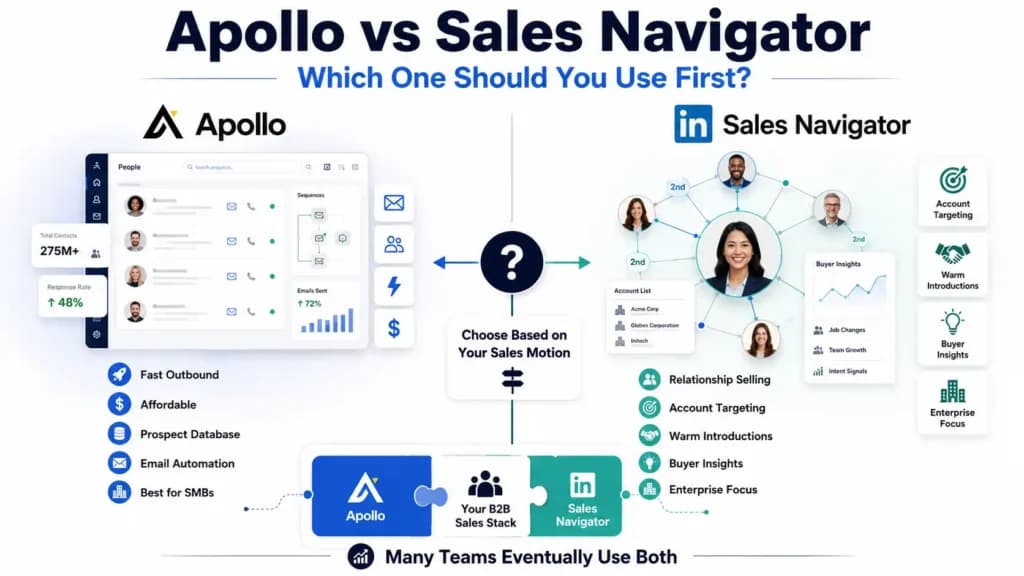
This is the question almost every growing team asks, and the honest answer depends on your selling motion, not on which tool sounds more impressive. If your sales process relies on warm introductions, relationship mapping, and selling into accounts where the deal size justifies a longer cycle, start with Sales Navigator and you can buy LinkedIn Sales Navigator for sales team use as your foundation. If you are a small or mid-size B2B business that needs to move fast, build outbound from scratch, and values cost efficiency over relationship depth, Apollo should come first. Many teams eventually run both – but the mistake is buying both on day one before understanding which selling motion actually drives your revenue.
This single decision is the difference between building the best sales tech stack for B2B teams and simply paying for two overlapping subscriptions.
🔥 LinkedIn Premium Business Plan 12 Months
Original Price ₹23,000 • Get it ₹8XXX
🤖 Gemini AI Advanced Pro Plan
Original Price ₹19,500 • Get it ₹8XXX
💼 LinkedIn Sales Navigator Core
Original Price ₹80,000 • Get it ₹2XXXX
🎨 Canva Pro Lifetime Access
Original Price ₹3,999 • Get it ₹4XX
📚 Coursera Plus Annual Plan
Original Price ₹33,000 • Get it ₹2XXX
✨ Adobe Creative Cloud All Apps
Original Price ₹59,000 • Get it ₹4XXX
How Sales Navigator and Apollo.io Work Together (Integration Workflow)
Here is what most comparison articles skip entirely: how sales navigator and apollo io integration actually plays out day to day. The typical flow looks like this – you find and qualify a prospect inside Sales Navigator using its filters and relationship signals, then you move that prospect into Apollo to enrich their contact details and pull verified email or phone data, and finally you launch outreach sequences from Apollo while tracking replies and follow-ups in one place.
The question of how does LinkedIn Sales Navigator work with Apollo io ultimately comes down to this handoff: Sales Navigator finds the right person, Apollo gets you in touch with them. Done manually, this workflow is where most teams lose hours every week, because every handoff between platforms is a place where a lead gets forgotten, duplicated, or simply falls out of the pipeline.
Workflow at a glance:
• Search and filter prospects inside Sales Navigator
• Export or match the same prospect inside Apollo for contact enrichment
• Launch a personalized outreach sequence from Apollo
• Sync replies and statuses back to your CRM or spreadsheet
How n8n Connects Sales Navigator + Apollo Into One Automated Workflow
This is where most guides stop – and where the real value starts. n8n is a workflow automation tool that sits quietly in the background and moves data between Sales Navigator, Apollo, your CRM, and your spreadsheet without anyone copying and pasting anything. A basic setup that lets you automate sales prospecting with n8n looks like this: a trigger watches for new leads matching your criteria, n8n pulls the relevant contact into Apollo for enrichment, checks for a verified email, then pushes the enriched lead straight into your outreach sequence or CRM record – all without a human touching a spreadsheet. Why build this instead of doing it manually? Because the friction between tools is exactly where leads get lost, and automation removes that friction permanently, not just for one campaign but for every campaign going forward.
Why You Should Bring Automation Into Your Prospecting Workflow
The case to automate sales prospecting with n8n comes down to one number: time. Manual prospecting research and data entry can eat up the majority of a rep’s day, leaving very little time for the actual conversations that close deals. When n8n handles the repetitive movement of data – checking for duplicates, enriching contacts, routing leads to the right rep – your team gets that time back. This is not about replacing salespeople with automation; it is about removing the parts of the job that were never really selling in the first place.
| Did You Know? Sales teams that automate repetitive prospecting tasks typically reclaim several hours per rep, per week – time that converts directly into more outbound conversations and, ultimately, more closed deals. |
Also Read – What Is LinkedIn Sales Navigator? The Ultimate Tool for B2B Leads
How to Build a Sales Tech Stack for a Small Business (Step-by-Step)
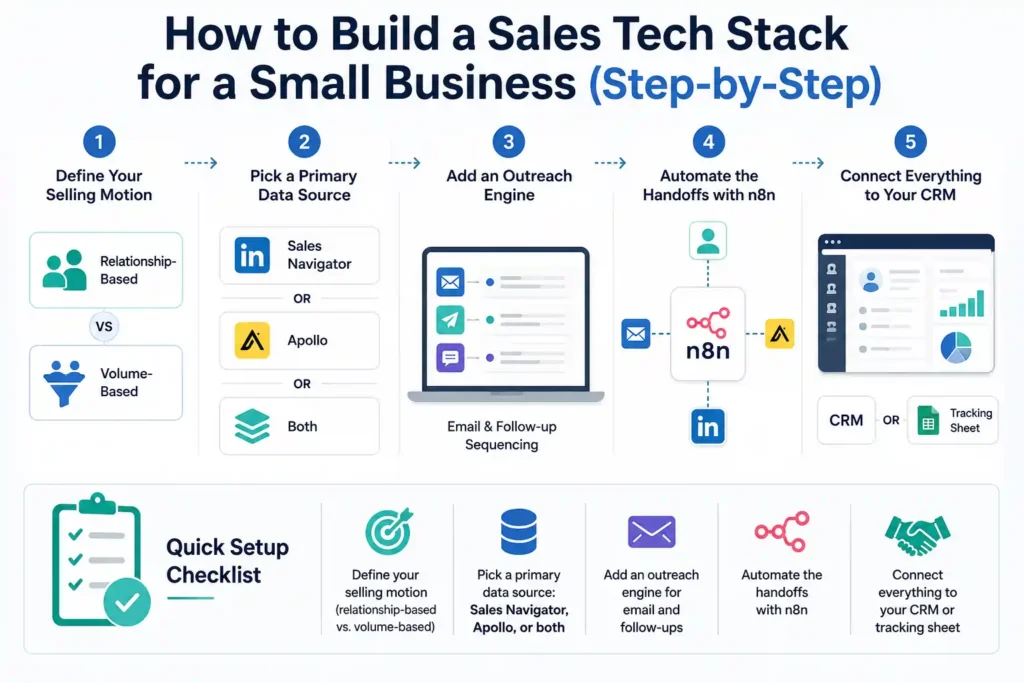
If you are wondering how to build a sales tech stack for small business needs specifically, the process does not need to be complicated. Start by mapping your actual selling motion – are you closing five-figure deals over months, or high volume deals over days? That answer decides whether Sales Navigator or Apollo leads your stack. Next, choose your data layer based on that answer, then layer in your outreach engine, whether that is Apollo’s built-in sequencing or a dedicated email tool. After that, add automation through n8n so leads move between tools without manual handling. Finally, connect everything to a simple CRM or even a well-organized spreadsheet so nothing falls through the cracks. This four-step approach is genuinely the best sales tech stack for B2B teams that are starting from scratch and do not want to overspend on tools they are not ready to use.
Quick Setup Checklist:
• Define your selling motion (relationship-based vs. volume-based)
• Pick a primary data source: Sales Navigator, Apollo, or both
• Add an outreach engine for email and follow-ups
• Automate the handoffs with n8n
• Connect everything to your CRM or tracking sheet
What Tools Do B2B Sales Teams Use in 2026? (Beyond the Core Three)
Sales Navigator, Apollo, and n8n cover the core of prospecting and automation, but most growing teams eventually add a few more layers as they scale. The table below breaks down where each layer fits.
| Layer | Purpose | Example Tools |
| Data & Intelligence | Finding and enriching leads | LinkedIn Sales Navigator, Apollo.io |
| Automation | Connecting tools and removing manual work | n8n, Zapier, Make |
| CRM / System of Record | Tracking deals and pipeline stages | HubSpot, Pipedrive, Zoho |
| Outreach & Engagement | Sending sequences and follow-ups | Apollo sequences, email tools |
| Content & Presentation | Proposals, decks, and creative assets | Canva, Notion |
You do not need every layer on day one. Most growing teams start with the first two – data and automation – and add the rest only once volume actually demands it.
Best Tools for Cold Outreach for a B2B Sales Team
When it comes to the best tools for cold outreach B2B sales team setups actually use, the combination of Sales Navigator, Apollo, and n8n covers nearly the entire workflow – and it remains one of the more dependable versions of the best sales tech stack for B2B teams looking to scale outbound without adding headcount. Sales Navigator identifies who to reach and when the timing is right. Apollo provides the actual contact information and the sequencing engine to send the message. And the sales navigator and apollo io integration, automated through n8n, makes sure no lead sits untouched between the two. The table below summarizes each tool’s specific role in cold outreach.
| Tool | Role in Cold Outreach |
| LinkedIn Sales Navigator | Identifies the right person and the right timing signal |
| Apollo.io | Supplies verified contact data and sends outreach sequences |
| n8n | Automates the handoff so no lead is manually managed |
AI Personalization in Outreach – What Actually Works
AI can help write faster, but it cannot replace genuine research, and this is where many teams building the best sales tech stack for B2B teams get the balance wrong. A fully AI-written cold email tends to read like a fully AI-written cold email, and prospects notice within the first line. The teams that actually see results use AI to handle the repetitive parts of the process – spotting patterns in which prospects respond, auto-filling missing data fields, and flagging duplicate contacts – while leaving the actual message personalization to a human who has read the prospect’s profile. When you automate lead generation workflow with n8n, the goal is not to automate the relationship itself, only the busywork that was standing in the way of it.
Also Read – Apollo.io Review 2026: Is This the Best B2B Lead Generation Tool for Sales Teams?
People Also Ask
What is the best tech stack for B2B sales?
The best sales tech stack for B2B teams in 2026 combines a data and intelligence layer like LinkedIn Sales Navigator or Apollo.io, an outreach engine for sending sequences, and an automation layer like n8n that connects everything without manual data entry.
Does Apollo.io integrate with LinkedIn Sales Navigator?
There is no official native integration between the two platforms, but teams commonly connect them through an automation tool like n8n, which moves leads from Sales Navigator into Apollo for enrichment and outreach. This is one of the most practical reasons businesses look for an Apollo.io alternative for lead generation that fits into an existing workflow rather than replacing it.
What tools do sales teams use for prospecting?
Most B2B sales teams in 2026 rely on a data layer such as Sales Navigator or Apollo, paired with a CRM and an automation tool to keep leads moving without manual handoffs.
Is LinkedIn Sales Navigator worth it for small sales teams?
It depends on your selling motion. Small teams selling into larger accounts with longer sales cycles typically see strong value, while high-volume outbound teams often get more from Apollo first.
How do I automate my sales outreach process?
Connect your data source, such as Sales Navigator or Apollo, to your CRM and outreach sequencer using a no-code automation tool like n8n, so new leads are enriched and routed automatically without manual entry.
So, Which Sales Tech Stack Should You Choose in 2026?
If you take one thing away from this guide, let it be this: the best sales tech stack for B2B teams is not the one with the most tools, it is the one with the least friction between them. Start with the data layer that matches your selling motion, add an outreach engine, automate the handoffs with n8n, and only add more once your volume genuinely demands it. The best sales tech stack for B2B teams is built in stages, not bought in one purchase.
| Ready to Build Your Sales Stack? Building this stack for your team and not sure where to start? PremiumToolsHub helps B2B teams and agencies set up exactly this kind of tool combination – talk to us on WhatsApp and get your sales stack running this week. |
Also Read – Sales Navigator vs Recruiter Lite: Which LinkedIn Plan Is Right for You in 2026?
So, Which Sales Tech Stack Should You Choose in 2026?
If you take one thing away from this guide, let it be this: the best sales tech stack for B2B teams is not the one with the most tools, it is the one with the least friction between them. Start with the data layer that matches your selling motion, add an outreach engine, automate the handoffs with n8n, and only add more once your volume genuinely demands it. The best sales tech stack for B2B teams is built in stages, not bought in one purchase.
Building this stack for your team and not sure where to start? PremiumToolsHub helps B2B teams and agencies set up exactly this kind of tool combination – talk to us on WhatsApp and get your sales stack running this week.