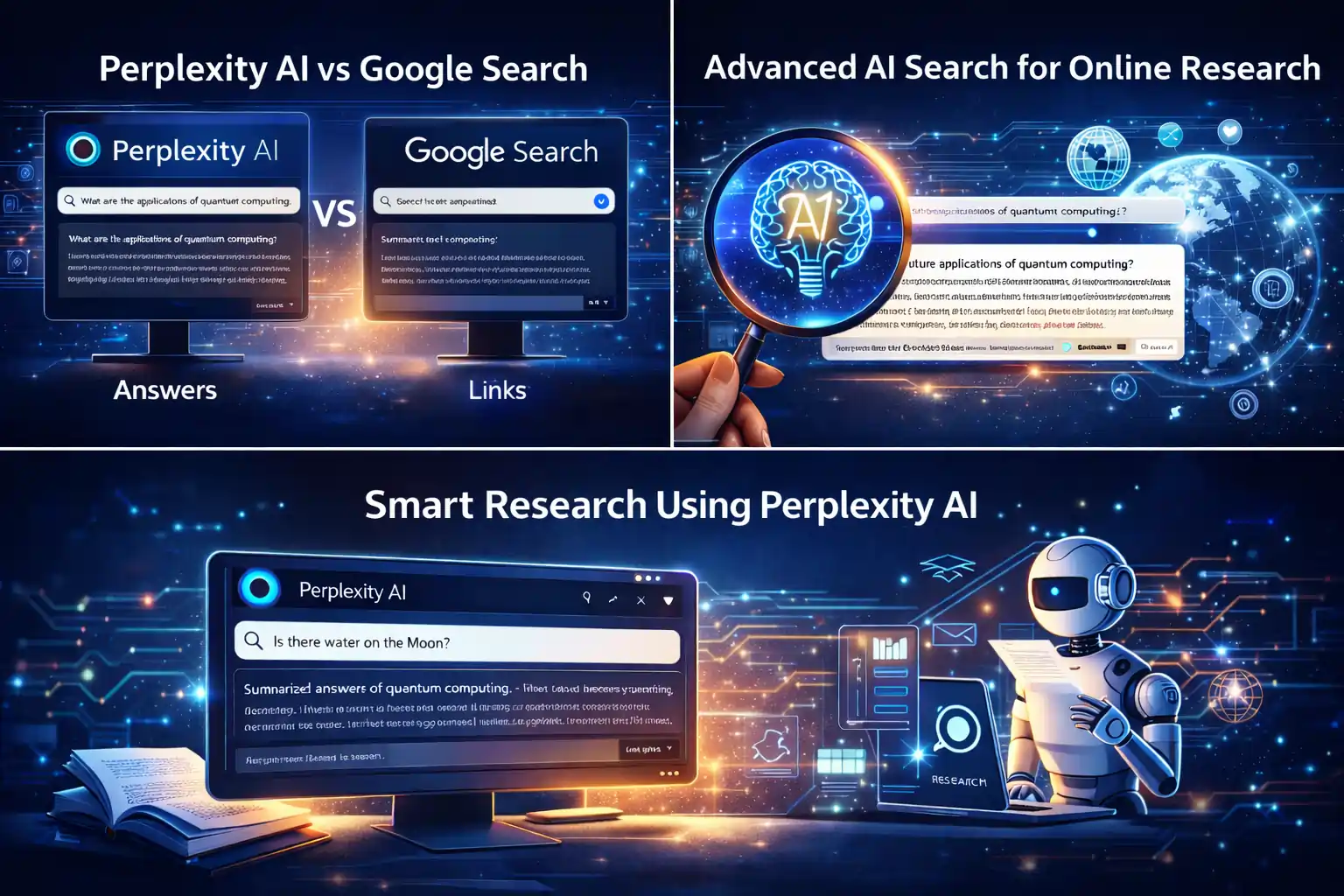
Introduction: Why Traditional Search Is No Longer Enough
For years, online search followed a predictable pattern. You typed a query, scanned a list of blue links, opened multiple pages, skipped ads, and stitched together answers on your own. This model worked when content was limited, but in today’s information-heavy internet, it feels slow and inefficient.
Modern users don’t want dozens of links-they want clear answers, backed by reliable sources, delivered quickly. This shift has fueled the rise of the AI search engine, where intent understanding matters more than keyword matching.
That’s where Perplexity AI enters the picture. Often called “the Google Killer for smart research,” Perplexity AI focuses on answer-driven search. Instead of overwhelming users with options, it summarizes information from the web and shows exactly where it came from.
In this guide, you’ll learn what is Perplexity AI, what is Perplexity AI and how it works, how to use Perplexity AI for research, how it compares in Perplexity vs Google, whether Perplexity AI is free or paid, and why many consider it the best AI tool for online research.
🔥 LinkedIn Premium Business Plan 12 Months
Original Price ₹23,000 • Get it ₹8XXX
🤖 Gemini AI Advanced Pro Plan
Original Price ₹19,500 • Get it ₹8XXX
💼 LinkedIn Sales Navigator Core
Original Price ₹80,000 • Get it ₹2XXXX
🎨 Canva Pro Lifetime Access
Original Price ₹3,999 • Get it ₹4XX
📚 Coursera Plus Annual Plan
Original Price ₹33,000 • Get it ₹2XXX
✨ Adobe Creative Cloud All Apps
Original Price ₹59,000 • Get it ₹4XXX
Understanding the Core Problem with Traditional Search
Traditional search engines were never designed for the scale of information we deal with today. When search engines were created, the web was smaller, content was limited, and users were willing to browse multiple pages. Over time, however, the internet has turned into a massive content ecosystem dominated by advertisements, affiliate pages, SEO-driven articles, and duplicate information.
For a user trying to research a topic, this creates three major problems. First is information overload, where too many sources provide conflicting or repetitive answers. Second is trust, because not all ranking pages are written for accuracy-many are written only to rank. Third is time waste, as users must manually verify information by opening several tabs.
This is the exact gap that AI-powered research tools aim to fill. Instead of showing “where information exists,” they focus on “what the correct answer is.” This shift in philosophy explains why tools like Perplexity AI are gaining popularity among researchers, students, and professionals.
Why Answer-Based Search Matters More Than Ever
Answer-based search is not just a trend-it is a response to how human behavior has evolved online. Users today multitask, skim content, and expect instant clarity. They don’t want to read five articles to understand one concept.
Perplexity AI fits this behavior perfectly because it removes
friction. Instead of sending users away from the platform, it keeps the research process focused. By summarizing information and attaching citations, it reduces mental effort while maintaining credibility.
This is also why answer-based search aligns well with voice search, AI assistants, and LLM-based systems. These systems prefer concise, well-structured answers that can be easily summarized, read aloud, or reused in AI-generated responses.
Also Read – How to Use Gemini Advanced for Daily Tasks
🔥 LinkedIn Premium Business Plan 12 Months
Original Price ₹23,000 • Get it ₹8XXX
🤖 Gemini AI Advanced Pro Plan
Original Price ₹19,500 • Get it ₹8XXX
💼 LinkedIn Sales Navigator Core
Original Price ₹80,000 • Get it ₹2XXXX
🎨 Canva Pro Lifetime Access
Original Price ₹3,999 • Get it ₹4XX
📚 Coursera Plus Annual Plan
Original Price ₹33,000 • Get it ₹2XXX
✨ Adobe Creative Cloud All Apps
Original Price ₹59,000 • Get it ₹4XXX
What is Perplexity AI?
Perplexity AI is an AI-powered search and research platform that provides direct, well-structured answers instead of traditional search result pages. It combines large language models with real-time web search to read multiple sources and present a concise, readable response.
Unlike conventional search engines, the Perplexity AI tool doesn’t leave interpretation to the user. It actively filters noise, removes repetition, and highlights the most relevant insights. This makes it ideal for research-heavy queries where clarity and accuracy matter more than browsing options.
What truly sets this Perplexity research tool apart is its citation-first approach. Every answer includes source links, allowing users to verify claims, explore deeper context, and reference information confidently in academic or professional work.
In simple terms, Perplexity AI isn’t just a search engine-it’s an answer engine built for people who want understanding, not endless scrolling
What Is Perplexity AI Used For?

Perplexity AI is designed for users who rely on information to learn, create, analyze, or decide. Its use cases extend far beyond casual browsing and are rooted in structured research.
Common uses include:
- Academic and educational research
- Content writing, blogging, and topic exploration
- Market, industry, and competitor research
- SEO planning and informational keyword analysis
- Fact-checking and quick knowledge validation
Because the Perplexity AI search focuses on explanation rather than discovery, it works best when the goal is understanding why something is true or how it works.
🔥 LinkedIn Premium Business Plan 12 Months
Original Price ₹23,000 • Get it ₹8XXX
🤖 Gemini AI Advanced Pro Plan
Original Price ₹19,500 • Get it ₹8XXX
💼 LinkedIn Sales Navigator Core
Original Price ₹80,000 • Get it ₹2XXXX
🎨 Canva Pro Lifetime Access
Original Price ₹3,999 • Get it ₹4XX
📚 Coursera Plus Annual Plan
Original Price ₹33,000 • Get it ₹2XXX
✨ Adobe Creative Cloud All Apps
Original Price ₹59,000 • Get it ₹4XXX
What Is Perplexity AI and How It Works (Behind the Scenes)
To understand what is Perplexity AI and how it works, it helps to look at its workflow.
First, Perplexity AI analyzes search intent. It understands natural language and conversational queries rather than treating searches as keyword strings. Next, it performs a real-time web search, pulling information from multiple authoritative sources.
Finally, the AI synthesizes the data. Instead of copying text, it extracts key ideas, removes redundancy, and organizes the information logically-then adds citations so users can verify every claim.
This process makes Perplexity AI feel like a digital research assistant, not a traditional search engine.
Perplexity AI as an AI Search Engine
Perplexity AI represents a new generation of the AI search engine, where answer quality matters more than page ranking. Traditional engines index and rank pages; the Perplexity AI search prioritizes understanding.
Instead of sending users across dozens of tabs, it resolves most queries directly within its interface. This reduces research time, cognitive load, and information overload.
Key characteristics of Perplexity AI search:
- Conversational queries with follow-ups
- Real-time information retrieval
- Summarized answers instead of raw links
- Built-in source transparency
How Perplexity AI Changes the Research Workflow (Before vs After)
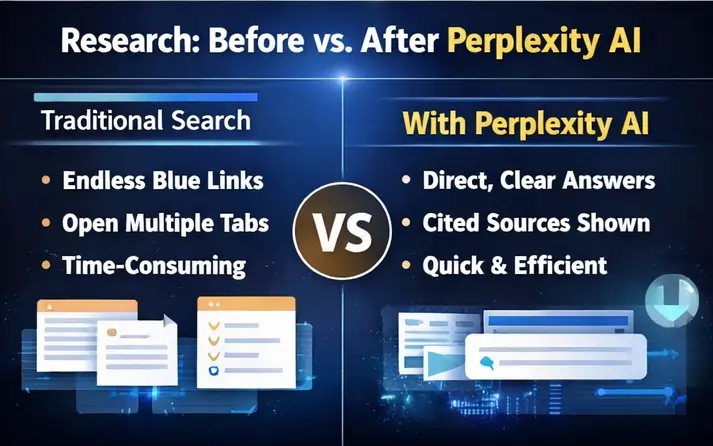
Before Perplexity AI
Before using Perplexity AI, a typical research workflow looked like this:
- Search the query on Google
- Open 5–10 ranking pages
- Ignore ads and popups
- Compare answers manually
- Verify credibility
- Summarize findings yourself
This process often took 30–90 minutes, depending on topic complexity.
After Perplexity AI
With Perplexity AI, the workflow changes dramatically:
- Ask one clear question
- Review a summarized answer
- Check cited sources
- Ask follow-up questions
This process often takes 5–10 minutes, making research far more efficient.
This difference alone explains why Perplexity AI is increasingly used as a primary research layer, even by users who still rely on Google for discovery.
How to Use Perplexity AI for Research (Step-by-Step)
Many users ask how to use Perplexity AI for research because it fits naturally into professional workflows.
Step 1: Ask clear, natural questions
Use full questions instead of keyword strings.
Step 2: Review cited sources
Check references to validate accuracy or explore deeper context.
Step 3: Refine with follow-ups
Ask comparison or clarification questions to narrow focus.
Step 4: Apply insights
Use the summarized findings for writing, studying, or decision-making.
Learning how to use Perplexity AI for research can replace hours of manual searching with minutes of focused understanding.
Perplexity AI vs Google Search
The comparison between Perplexity AI vs Google search is inevitable, but both tools serve different goals.
Google excels at discovery-local searches, shopping, navigation, and breaking news. However, research-heavy queries often require opening multiple pages and evaluating credibility manually.
Perplexity AI is built for understanding. It removes ads, reduces noise, and delivers summarized answers with citations. Rather than replacing Google, it complements Google by handling research tasks Google wasn’t optimized for.
Perplexity vs Google: A Deep Research Comparison
When evaluating Perplexity vs Google for research, the difference becomes clear.
| Aspect | Perplexity AI | |
| Research speed | Very fast | Slower (manual) |
| Ads & clutter | Minimal | High |
| Citations | Built-in | Manual |
| Best for | Understanding | Discovery |
In short, Google is excellent for navigation, while Perplexity AI excels at analysis and synthesis.
Perplexity AI vs ChatGPT, Bing AI, and Google SGE
AI tools aren’t interchangeable.
- ChatGPT is ideal for creativity, brainstorming, and drafting.
- Bing AI and Google SGE enhance traditional search with AI summaries.
- Perplexity AI is built specifically for verifiable research.
For factual accuracy and source transparency, Perplexity AI stands out.
Industry-Wise Use Cases of Perplexity AI
Perplexity AI adapts across roles:
- Students: concept clarity, exam prep, credible sources
- Bloggers & creators: topic research, outlines, fact validation
- SEO professionals: intent analysis, topical authority
- Journalists: background research and fact-checking
- Business teams: market insights and strategy research
Where information quality matters, Perplexity AI delivers value.
Why Google Is Responding with AI Overviews
The rise of Perplexity AI has not gone unnoticed. Google’s introduction of AI Overviews is a clear response to changing user behavior.
However, Google still operates within an ad-driven ecosystem, which limits how far it can go with pure answer-based search. This is why many users feel that Perplexity AI offers a cleaner research experience, even if Google remains dominant overall.
Understanding this competitive landscape helps explain why Perplexity AI is often compared directly with Google, even though both tools serve different purposes.
Als0 Read – Gemini Advanced vs ChatGPT Plus – Which Is Worth It?
The Role of Citations in Building AI Trust
Citations are not just a feature-they are a trust mechanism. In an era where AI hallucinations are a real concern, showing sources is critical.
Perplexity AI’s citation-first model:
- Improves transparency
- Encourages verification
- Builds long-term credibility
This approach aligns closely with Google’s EEAT principles and makes Perplexity AI suitable for serious research.
How Perplexity AI Handles Complex & Multi-Part Questions
One of the biggest limitations of traditional search engines is their difficulty in handling complex or layered queries. Questions like “How does AI search impact SEO in 2026?” or “Compare AI search engines for academic research” usually require reading multiple sources.
Perplexity AI is designed specifically for such queries. It breaks down the question internally, searches for relevant subtopics, and then synthesizes a complete answer. This ability to connect dots across sources is what makes it powerful for advanced research.
This is also where Perplexity AI differs from generic chatbots. Instead of guessing or hallucinating answers, it grounds responses in real-time web data.
Perplexity AI for Students: A Deeper Look
For students, Perplexity AI is more than a convenience tool-it is a learning accelerator. Many students struggle not because information is unavailable, but because it is scattered and difficult to understand.
- Explaining concepts in simple language
- Providing references for further reading
- Reducing dependency on unreliable blogs
- Supporting ethical learning instead of plagiarism
By encouraging understanding rather than copying, Perplexity AI supports deeper learning outcomes.
Perplexity AI for Bloggers & Content Creators
Content creators often spend more time researching than writing. Perplexity AI reduces this burden by acting as a pre-writing research engine.
Creators use it to:
- Understand topic depth
- Identify subtopics worth covering
- Validate claims before publishing
- Avoid misinformation
This leads to higher-quality, more authoritative content-something Google increasingly rewards.
Perplexity AI for SEO Professionals
SEO has moved beyond keywords into intent, context, and authority. Perplexity AI fits perfectly into this evolution.
Advanced SEO teams use Perplexity AI to:
- Analyze how AI systems interpret queries
- Understand semantic relationships
- Prepare content for AI Overviews
- Improve topical coverage
By studying how Perplexity AI answers questions, SEOs gain insight into how future search systems may evaluate content quality.
Perplexity AI for SEO & Content Strategy
From an SEO perspective, the Perplexity AI tool complements keyword tools by providing context. It helps teams understand what users actually want to know and which subtopics matter most.
This supports:
- Pillar–cluster content planning
- People Also Ask optimization
- AI Overview readiness
- EEAT-focused writing
Is Perplexity AI Free or Paid?
A common question is is Perplexity AI free or paid.
- Free plan: Unlimited basic searches with citations
- Paid plan: Advanced models, deeper research, document analysis
For many users, the free tier is enough; professionals benefit from paid features.
Accuracy, Trust, and Privacy
Perplexity AI improves trust by grounding answers in live sources and showing citations. This reduces hallucinations and enables verification.
Users should still apply critical thinking for high-stakes decisions and avoid sharing sensitive data. Think of Perplexity AI as a research assistant, not a final authority.
Why Perplexity AI Is the Best AI Tool for Online Research
Because it combines real-time data, structured explanations, and transparent citations, many professionals consider Perplexity AI the best AI tool for online research. It saves time while improving clarity and trust.
Limitations of Perplexity AI
Perplexity AI isn’t designed for transactional searches like shopping or bookings and may be less effective for local queries. Accuracy also depends on source quality, so verification remains important.
Is Perplexity AI Really the “Google Killer”?
The phrase “Google Killer” is catchy but misleading. Perplexity AI doesn’t aim to replace Google entirely-it kills inefficient research workflows.
Both tools are likely to coexist, each serving different user needs.
Final Verdict: Should You Use Perplexity AI?
If your work involves research, learning, or information-driven decisions, Perplexity AI can dramatically improve efficiency. It won’t replace Google for everything, but for smart research, it offers a faster, cleaner, and more reliable experience.
In short, Perplexity AI may not kill Google-but it definitely kills wasted research time.
Long-Term Impact of AI Search on the Internet
AI search engines will change how content is created and consumed. As answer-based systems grow, shallow content will lose relevance, while deep, authoritative content will gain value.
Perplexity AI represents this shift clearly. It rewards clarity, credibility, and completeness-signals that are likely to dominate future search ecosystems.
Final Conclusion
Perplexity AI is not just another AI tool-it represents a shift in how humans interact with information. By focusing on answers instead of links, clarity instead of clutter, and trust instead of traffic, it addresses many of the frustrations users face with traditional search.
While it may never replace Google entirely, Perplexity AI excels where Google struggles: efficient, trustworthy research. For students, professionals, creators, and analysts, this makes it an indispensable companion in the modern information landscape.
In short, Perplexity AI may not kill Google-but it is clearly reshaping the future of search.
FAQs (People Also Ask)
What is Perplexity AI?
Perplexity AI is an AI-powered search platform that provides direct answers with citations from real-time web sources.
How does Perplexity AI work?
It analyzes intent, searches the live web, synthesizes information, and presents cited answers.
Is Perplexity AI better than Google?
For research and explanations, yes. For discovery and local searches, Google is better.
Is Perplexity AI free or paid?
It offers both free and paid plans.
Is Perplexity AI trustworthy?
Yes, because it provides source citations, allowing users to verify information.
Who should use Perplexity AI?
Students, researchers, bloggers, SEO professionals, journalists, and analysts