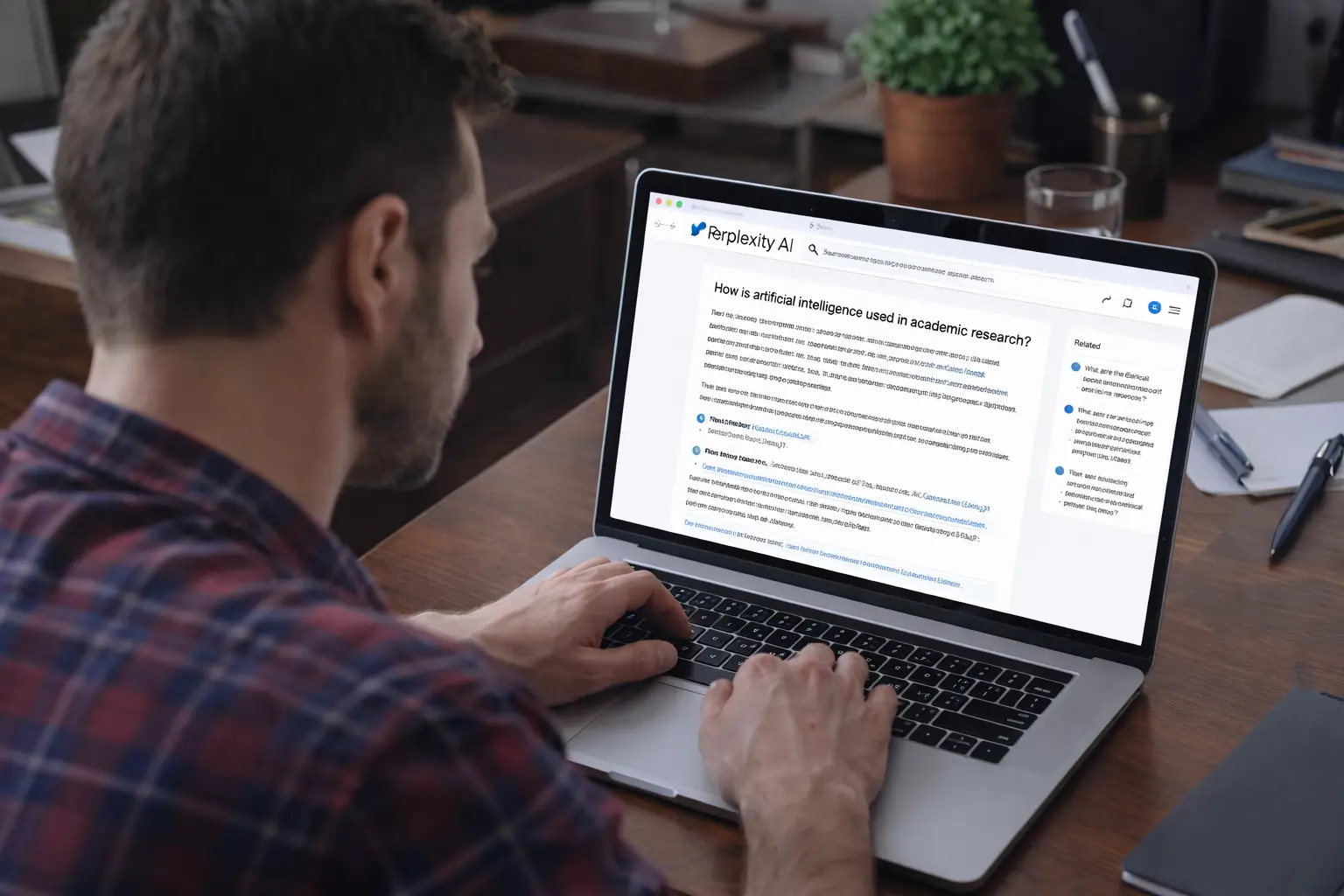
Online research has evolved rapidly. Earlier, research meant opening multiple tabs, scanning long articles, and manually verifying information. Today, AI-powered tools are changing that workflow completely. One of the most effective tools in this space is Perplexity AI.
If you are searching for How to use Perplexity AI, this guide will help you understand not only the basics but also advanced, practical research workflows. Whether you are a student, academic researcher, writer, or professional, this article explains how to use Perplexity AI effectively for real-world research needs.
By the end, you will know how to use Perplexity AI for academic research, writing, literature reviews, and structured learning.
How to Use Perplexity AI for Research
To use Perplexity AI for research:
-
Ask a clear and specific question
-
Review the AI-generated answer carefully
-
Check the cited sources for accuracy
-
Refine the query with follow-up questions
-
Validate important information before using it
This approach makes Perplexity AI a reliable research assistant rather than just another search engine.
🔥 LinkedIn Premium Business Plan 12 Months
Original Price ₹23,000 • Get it ₹8XXX
🤖 Gemini AI Advanced Pro Plan
Original Price ₹19,500 • Get it ₹8XXX
💼 LinkedIn Sales Navigator Core
Original Price ₹80,000 • Get it ₹2XXXX
🎨 Canva Pro Lifetime Access
Original Price ₹3,999 • Get it ₹4XX
📚 Coursera Plus Annual Plan
Original Price ₹33,000 • Get it ₹2XXX
✨ Adobe Creative Cloud All Apps
Original Price ₹59,000 • Get it ₹4XXX
Why Perplexity AI is Designed for Research
Traditional search engines focus on ranking web pages. Perplexity AI focuses on understanding questions and delivering direct answers. This shift is especially valuable when the goal is learning, analysis, or research rather than browsing.
Instead of forcing users to click multiple links, Perplexity summarizes information and shows citations alongside answers. This helps users understand:
-
What the answer is
-
Where the information comes from
-
How reliable the source is
Because of this, Perplexity AI is increasingly seen as a dedicated research tool rather than a general search engine.
Read Also: What Is Perplexity AI?
Getting Started: How to Use Perplexity AI Correctly
If you are new and following a Perplexity AI tutorial, the first step is learning how to ask the right questions. Perplexity performs best when queries are specific and clearly framed.
For example-
-
Instead of asking “artificial intelligence”
-
Ask “How is artificial intelligence used in academic research?”
The more precise the question, the more useful the answer will be.
Once the answer appears, take time to:
-
Read the summary
-
Review the cited sources
-
Ask follow-up questions for clarity
This habit forms the foundation of how to use Perplexity AI effectively.
🔥 LinkedIn Premium Business Plan 12 Months
Original Price ₹23,000 • Get it ₹8XXX
🤖 Gemini AI Advanced Pro Plan
Original Price ₹19,500 • Get it ₹8XXX
💼 LinkedIn Sales Navigator Core
Original Price ₹80,000 • Get it ₹2XXXX
🎨 Canva Pro Lifetime Access
Original Price ₹3,999 • Get it ₹4XX
📚 Coursera Plus Annual Plan
Original Price ₹33,000 • Get it ₹2XXX
✨ Adobe Creative Cloud All Apps
Original Price ₹59,000 • Get it ₹4XXX
Understanding Perplexity AI Features for Research
Before going deeper, it is important to understand the core Perplexity AI features that support research.
|
Feature |
Research Benefit |
|
Source citations |
Helps verify information |
|
Answer summaries |
Saves time |
|
Follow-up questions |
Improves depth |
|
Conversational flow |
Refines research direction |
These features are what make Perplexity different from a standard AI chatbot.
How to Use Perplexity AI for Academic Research
Many users want to know how to use Perplexity AI for academic research without compromising accuracy or credibility.
Academic research demands careful sourcing and context. Perplexity AI supports this by clearly displaying citations, which allows researchers to trace information back to original sources.
The best approach is to use Perplexity AI to:
-
Understand complex concepts
-
Identify relevant sources
-
Explore multiple perspectives
Once the sources are identified, researchers should always consult the original material directly before citing it in academic work. This balanced workflow ensures academic integrity while saving time.
How Students Can Use Perplexity AI Effectively
Students often ask how to use Perplexity AI for students in a way that supports learning rather than shortcuts it.
Perplexity AI is especially useful for-
-
Understanding difficult topics
-
Summarizing concepts
-
Preparing for exams or assignments
It helps students break down complex ideas into simpler explanations. However, students should avoid copying AI-generated answers directly.
Used responsibly, Perplexity AI becomes a study companion that improves comprehension and critical thinking.
How Writers Can Use Perplexity AI for Research
Another common query is how to use Perplexity AI for writers.
Writers benefit from Perplexity AI during the research and planning stages. It helps them:
-
Understand unfamiliar topics quickly
-
Verify facts
-
Explore related ideas
Many writers use Perplexity AI to build outlines, gather background information, and validate claims before writing. The key is to use Perplexity AI as a research assistant while maintaining an original writing voice.
Using Perplexity AI for Literature Reviews
If you are exploring how to use Perplexity AI for literature review, structure is essential.
Literature reviews require:
-
Identifying key themes
-
Finding influential studies
-
Understanding how ideas evolve over time
Perplexity AI helps by surfacing relevant sources and summarizing viewpoints, allowing researchers to map the research landscape quickly.
However, it should be used to organize and discover sources, not to replace reading original research papers. It works best as a starting point that guides deeper investigation.
Perplexity AI Tips for Better Research Results
Applying smart Perplexity AI tips can significantly improve output quality.
Two highly effective practices are:
-
Breaking large questions into smaller, focused ones
-
Cross-checking answers by running multiple related queries
These habits reduce bias, improve accuracy, and lead to more reliable research outcomes.
Common Mistakes to Avoid When Using Perplexity AI
Even powerful tools can produce misleading results if used incorrectly.
Avoid-
-
Treating AI-generated answers as absolute truth
-
Skipping citation checks
-
Asking vague or overly broad questions
-
Relying on a single response
Perplexity AI is most effective when combined with human judgment and verification.
Perplexity AI vs Traditional Research Methods
Traditional research often involves manually reviewing dozens of articles. Perplexity AI changes this by acting as a fast discovery layer.
It excels at:
-
Summarizing information
-
Identifying relevant sources
Traditional research remains essential for deep reading and final analysis. When both methods are combined, research becomes faster and more accurate.
🔥 LinkedIn Premium Business Plan 12 Months
Original Price ₹23,000 • Get it ₹8XXX
🤖 Gemini AI Advanced Pro Plan
Original Price ₹19,500 • Get it ₹8XXX
💼 LinkedIn Sales Navigator Core
Original Price ₹80,000 • Get it ₹2XXXX
🎨 Canva Pro Lifetime Access
Original Price ₹3,999 • Get it ₹4XX
📚 Coursera Plus Annual Plan
Original Price ₹33,000 • Get it ₹2XXX
✨ Adobe Creative Cloud All Apps
Original Price ₹59,000 • Get it ₹4XXX
When Perplexity AI Is Most Useful
Perplexity AI is particularly useful when:
-
Time is limited
-
Topics are complex
-
Source credibility matters
It supports researchers, students, writers, and professionals who want efficiency without sacrificing accuracy. It is not a replacement for critical thinking, but a tool that enhances it.
Conclusion: How to Use Perplexity AI the Right Way
Understanding how to use Perplexity AI correctly can transform the way you research online. It reduces time spent searching, improves clarity, and supports fact-based learning.
The most effective users treat Perplexity AI as a research assistant, not a shortcut. By verifying sources, refining questions, and combining AI insights with human judgment, researchers can achieve better outcomes.
Used responsibly, Perplexity AI is one of the most powerful tools available for modern research.
FAQs (People Also Ask Optimized)
1. How to use Perplexity AI for beginners?
Beginners should start with clear questions and carefully review cited sources.
2. Is Perplexity AI good for academic research?
Yes, especially for discovery and summarization, but sources must be verified.
3. Can students rely fully on Perplexity AI?
No, it should support learning, not replace original study.
4. How accurate is Perplexity AI research?
It is generally accurate when citations are reviewed properly.
5. Is Perplexity AI better than Google for research?
For explanations and summaries, yes. For navigation, no.
6. Can writers use Perplexity AI for content research?
Yes, it is widely used by writers for background research.
7. Does Perplexity AI help with literature reviews?
Yes, it helps identify sources and research themes efficiently.