
If you are building a startup, one of the biggest early decisions is which tools to use. The best tools for startups are not necessarily the most expensive ones. They are the ones that help your team move faster, save money, and stay organised without creating unnecessary complexity.
Startup tools are software applications and platforms that help new businesses manage daily operations, automate repetitive tasks, create content, attract customers, and grow revenue. In 2026, the landscape of tools for new businesses has expanded significantly, with powerful AI-based options now available at various price points.
This guide covers the essential startup software stack every founder should know about – from AI assistants to marketing tools – and helps you decide which ones are right for your stage and budget. Whether you are pre-revenue or already scaling, the right combination of tools makes a measurable difference.
What Are the Best Tools for Startups in 2026?
The best tools for startups in 2026 include AI assistants like ChatGPT Plus and Gemini Advanced, automation platforms like n8n, design tools like Canva Pro and Adobe Creative Cloud, project management tools like Notion, and marketing tools like LinkedIn Sales Navigator. The right combination depends on your team size, industry, and growth stage.
The tools startups need generally fall into six core categories: AI and productivity, marketing and outreach, design and creative work, automation, communication, and analytics. The must have tools for startups 2026 are those that directly reduce manual work, bring in customers, or keep the team aligned.
In 2026, AI has changed the game significantly. Tasks that used to require specialist skills – writing, data analysis, design, coding – are now manageable for small teams with the right tools. This makes the best tools for startups more powerful and more accessible than ever before, even for bootstrapped founders with limited budgets.
Also Read – Best AI Tools for Digital Marketing Agencies in 2026 – The Ultimate Guide
🔥 LinkedIn Premium Business Plan 12 Months
Original Price ₹23,000 • Get it ₹8XXX
🤖 Gemini AI Advanced Pro Plan
Original Price ₹19,500 • Get it ₹8XXX
💼 LinkedIn Sales Navigator Core
Original Price ₹80,000 • Get it ₹2XXXX
🎨 Canva Pro Lifetime Access
Original Price ₹3,999 • Get it ₹4XX
📚 Coursera Plus Annual Plan
Original Price ₹33,000 • Get it ₹2XXX
✨ Adobe Creative Cloud All Apps
Original Price ₹59,000 • Get it ₹4XXX
Why Does Every Startup Need a Strong Software Stack?
Startups operate under a unique set of constraints. Time is limited, budgets are tight, and the team is usually small. In this environment, the wrong tools do not just waste money – they waste the one resource startups cannot afford to lose, which is time.
A strong startup software stack acts like a multiplier. When your team uses the right tools, one person can do the work of three. A founder using an AI writing assistant can produce marketing content in hours instead of days. A sales team using LinkedIn Sales Navigator integrated with a CRM can track leads without maintaining separate spreadsheets or risking follow-ups slipping through.
Without a clear software strategy, startups often end up subscribing to too many tools, creating workflow confusion and unnecessary costs. Many early-stage companies use five or more overlapping tools when two or three well-chosen ones would be far more effective. This problem – sometimes called tool sprawl – is one of the most common productivity drains in early-stage teams.
Strong startup productivity tools also directly impact team morale. When processes are smooth and information is easy to find, teams stay focused and energised. When workflows are fragmented, frustration builds and coordination becomes its own full-time job. Choosing the right tools for new businesses from the start prevents this pattern from developing as your team and operations grow.
Which Categories of Tools Does a Startup Actually Need?
Not every startup needs the same set of tools. However, there are six core categories that apply to most early-stage businesses. Understanding these helps you build a focused startup software stack that covers your actual needs without overspending on tools you do not use.
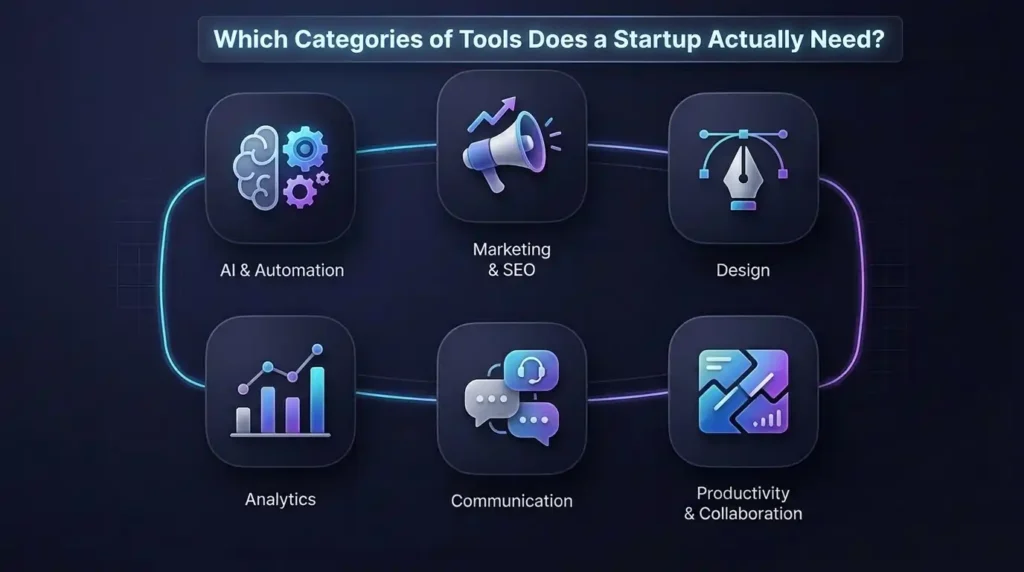
AI and automation tools
AI tools help startups write content, answer customer queries, generate ideas, and research faster. Startup automation tools like n8n and Make.com connect your apps and run workflows automatically, saving hours every week. AI assistants like ChatGPT Plus and Gemini Advanced support content creation, research, and customer communication at scale – tasks that would otherwise require additional headcount.
Marketing and SEO tools
Marketing tools help startups reach their target audience, build brand awareness, and generate leads. Tools like LinkedIn Sales Navigator support B2B outreach, while SEO platforms help startups rank on search engines. The right startup marketing tools list depends on your channels – whether you focus on organic search, social media, email, or paid advertising – and should be built around your primary customer acquisition method.
Design and creative tools
Even if you are not a designer, your startup needs visual content for social media, presentations, product pages, and pitches. Tools like Canva Pro and Adobe Creative Cloud give teams the ability to create professional visuals without hiring a full-time designer. These are among the software tools for small startups that pay back their cost quickly, often within the first month of consistent use.
Productivity and collaboration tools
Tools like Notion and Slack help your team stay aligned, track tasks, and share information efficiently. Startup productivity tools in this category reduce email clutter, improve project visibility, and ensure nothing falls through the cracks as your team grows. These are the must have tools for startups 2026 that support internal operations – the backbone of a well-functioning team.
Also Read – LinkedIn Premium vs Sales Navigator: Which LinkedIn Plan Is Best for You in 2026?
🔥 LinkedIn Premium Business Plan 12 Months
Original Price ₹23,000 • Get it ₹8XXX
🤖 Gemini AI Advanced Pro Plan
Original Price ₹19,500 • Get it ₹8XXX
💼 LinkedIn Sales Navigator Core
Original Price ₹80,000 • Get it ₹2XXXX
🎨 Canva Pro Lifetime Access
Original Price ₹3,999 • Get it ₹4XX
📚 Coursera Plus Annual Plan
Original Price ₹33,000 • Get it ₹2XXX
✨ Adobe Creative Cloud All Apps
Original Price ₹59,000 • Get it ₹4XXX
What Are the Best AI Tools for Startups in 2026?
The best ai tools for startups in 2026 include ChatGPT Plus for content and customer support, Gemini Advanced for research and data tasks, n8n for workflow automation, Notion AI for project management, and Perplexity Pro for real-time information. These startup automation tools reduce manual work and help small teams operate with the efficiency of a much larger organisation.
AI tools have become one of the most important categories within the best tools for startups ecosystem. In 2026, AI assistants are no longer a luxury – they are a practical necessity for any startup trying to compete without a large team.

ChatGPT Plus helps founders draft proposals, emails, blog content, and social media posts in a fraction of the normal time. Gemini Advanced is particularly useful for research, summarising long documents, and working with Google Workspace data. For automation, n8n stands out because it allows you to build complex workflows connecting different apps without writing code – making it ideal for startup automation tools use cases like lead routing, content publishing, and internal notifications.
The table below compares the most widely used AI tools for startups in 2026 across four key dimensions:
| Tool | Primary Use | Best For | Free Plan |
| ChatGPT Plus | Content creation, support | Founders, marketers | Yes (limited) |
| Gemini Advanced | Research, data analysis | Google Workspace teams | Yes (basic) |
| Perplexity Pro | Real-time web research | Researchers, consultants | Yes (limited) |
| n8n | Workflow automation | Teams with repeat processes | Yes (self-hosted) |
| Notion AI | Project management, notes | Small teams, solopreneurs | Yes (limited) |
| Claude Pro | Writing, analysis, coding | Technical founders, writers | Yes (basic) |
These affordable saas tools are available at different price points, and several offer free tiers that are sufficient for early-stage startups with lean budgets. As your needs grow, upgrading individual tools – or accessing premium versions through shared plans – is a practical way to scale your capability without a large upfront investment.
Which Are the Best Affordable SaaS Tools for Startups?
The best tools for startups on a budget are those available through shared or team access plans. Platforms like Canva Pro, Grammarly Premium, Notion Business, and LinkedIn Premium can be accessed through verified shared access providers at a fraction of their individual subscription cost – making them practical affordable saas tools for bootstrapped teams.
The cost of SaaS subscriptions adds up quickly. A startup with five team members paying individually for design, writing, automation, and communication tools could easily spend significant amounts per month before generating consistent revenue. This is one of the most common budget surprises for early-stage founders.
This is where affordable saas tools through shared access models become practical. Legitimate platforms like PremiumToolsHub offer verified shared team access to premium tools at a fraction of the official price. This works through family plans, team licenses, and authorised reseller programs – not through cracked or stolen accounts.
For cheap tools for startups in the early stage, the strategy is simple: start with free tiers, identify which tools your team uses daily, and then upgrade only those specific ones – ideally through a shared access plan to reduce per-seat costs. A five-person team accessing Adobe Creative Cloud, Grammarly, and Notion through a shared plan typically pays considerably less than the sum of five individual subscriptions.
This approach keeps software tools for small startups within a manageable monthly budget while ensuring your team has full access to premium features when they need them. The key is choosing tools strategically rather than subscribing to everything at once.
Also Read – What Is Lovable AI? The AI Web Engineer That Builds Apps for You
🔥 LinkedIn Premium Business Plan 12 Months
Original Price ₹23,000 • Get it ₹8XXX
🤖 Gemini AI Advanced Pro Plan
Original Price ₹19,500 • Get it ₹8XXX
💼 LinkedIn Sales Navigator Core
Original Price ₹80,000 • Get it ₹2XXXX
🎨 Canva Pro Lifetime Access
Original Price ₹3,999 • Get it ₹4XX
📚 Coursera Plus Annual Plan
Original Price ₹33,000 • Get it ₹2XXX
✨ Adobe Creative Cloud All Apps
Original Price ₹59,000 • Get it ₹4XXX
What Is the Best Startup Marketing Tools List for 2026?
The best startup marketing tools list for 2026 includes LinkedIn Sales Navigator for B2B outreach, Canva Pro for content design, Grammarly for writing quality, Google Analytics for website data, and Mailchimp for email campaigns. Together, these tools cover the core marketing functions most startups need in the early growth stage.
Marketing is where many startups struggle because they try to do too much with too little. A focused set of startup productivity tools for marketing is far more effective than subscribing to ten different platforms and using none of them consistently. The goal is to cover your primary acquisition channel well rather than spreading effort thin across every possible platform.
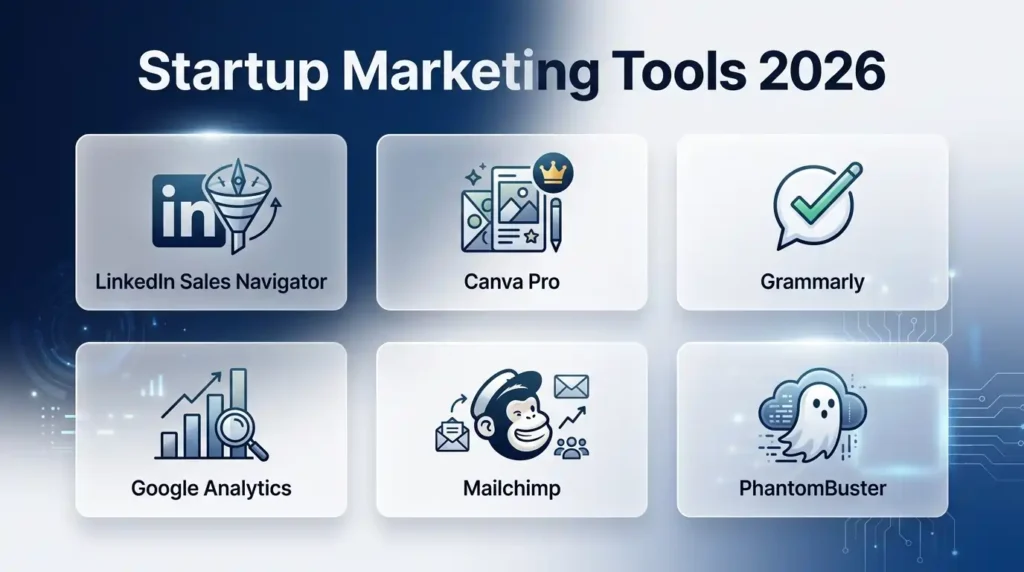
For B2B startups, LinkedIn remains the most powerful channel for reaching decision-makers directly. For D2C and content-driven startups, a combination of SEO tools and email marketing delivers the best long-term return. The startup marketing tools list below covers both scenarios:
| Tool | Function | Best For | Budget Fit |
| LinkedIn Sales Navigator | B2B lead generation | SaaS, agencies, consultants | Medium |
| Canva Pro | Visual content creation | Social media, pitches | Low–Medium |
| Grammarly Premium | Writing quality | Blogs, emails, proposals | Low |
| Google Analytics | Website traffic data | All startups with website | Free |
| Mailchimp | Email marketing | D2C, SaaS, content brands | Free (limited) |
| PhantomBuster | LinkedIn automation | Sales-led growth teams | Medium |
These are the best tools for startups focused on growth marketing. The exact combination depends on whether your startup is B2B or B2C, which stage you are at, and which channels your target audience actually uses. Start with two or three of these tools and add more as your marketing strategy becomes clearer.
How to Build a Startup Software Stack Without Overspending?
Building a startup software stack does not mean signing up for every tool available. The most effective approach is to start with the minimum and add tools only when a clear, specific need emerges. Here is a practical step-by-step process that keeps costs under control while ensuring your team has what it needs:
- Start with free tiers of essential tools. Google Workspace, Notion free, Canva free, and a basic email marketing platform cover most early-stage needs without any subscription cost.
- Identify which manual tasks take the most time each week. These are the best candidates for startup automation tools – tasks that are repetitive, rule-based, and time-consuming.
- Upgrade only the tools your team uses every day. Avoid paying for tools that get opened once a month. If you cannot remember the last time someone on your team logged in, cancel that subscription.
- Use shared access plans for premium tools. Accessing LinkedIn Premium, Adobe Creative Cloud, or Grammarly through a verified shared access provider like PremiumToolsHub reduces your monthly software costs significantly.
- Review your stack every 90 days. Remove tools that are not generating clear, measurable value. Technology debt – paying for unused tools – is a real cost that accumulates quietly.
A practical cost comparison: a startup using full individual subscriptions for five tools might spend between ₹8,000 and ₹12,000 per month. The same set of cheap tools for startups accessed through shared plans can cost under ₹3,000 per month with no compromise on features. For software tools for small startups, this difference is significant – especially in the early stages when every rupee needs to work hard.
Also Read – How to Use Jasper AI for Content Marketing
Who Should Use These Startup Productivity Tools?
Startup productivity tools are relevant across different types of early-stage businesses, but not every tool fits every situation. Understanding who benefits most helps you make better decisions about where to invest your software budget.
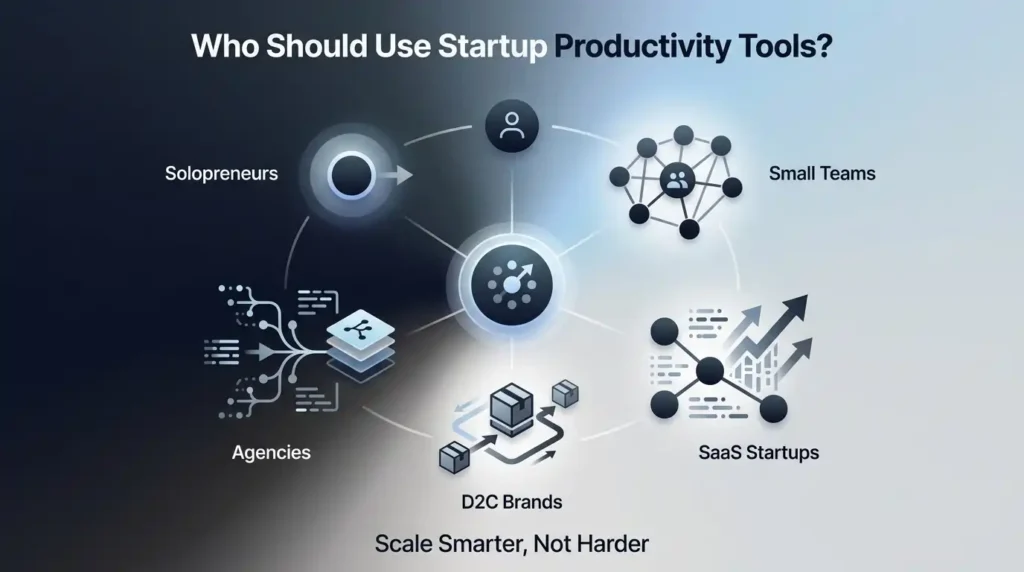
Who should use these tools:
- Solopreneurs and freelancers who need to manage multiple business functions alone without hiring additional help
- Small founding teams of two to ten people handling sales, marketing, and operations simultaneously
- Agencies managing multiple clients who need to automate repetitive tasks and maintain consistent output quality
- D2C brands that need content creation, customer communication, and analytics tools to compete with larger players
- SaaS startups that depend on LinkedIn outreach, content marketing, and automation workflows for lead generation
Who may not need all these tools right now:
- Startups still in the ideation or validation phase that have not yet confirmed their product-market fit
- Businesses in highly regulated industries where specific enterprise software is mandated by compliance requirements
- Founders who work primarily offline or in industries where digital marketing is not the primary customer acquisition channel
The best tools for startups deliver value only when they are aligned with your actual workflow. The right time to invest in tools for new businesses is when a clear gap exists in your current process that a tool can directly and measurably solve.
When Is the Right Time for a Startup to Invest in Premium Tools?
Not every startup needs premium tools from day one. The decision to upgrade from free to paid software should be driven by specific, observable signals – not by the assumption that premium always means better results.
Here are the clearest signals that it is time to upgrade your tools:
- Your team is spending more than five hours per week on a task that a paid tool could automate or significantly speed up
- Free plan limits are actively blocking your workflow – for example, export limits in design tools, user caps in project management software, or message limits in communication platforms
- You are losing leads or customers because of slow communication, poor content quality, or unprofessional presentation
- You have validated your business model and are now focused on scaling, where efficiency improvements directly translate to revenue growth
For affordable saas tools, the upgrade decision should always come with a clear return expectation. If a LinkedIn Sales Navigator subscription helps your team book two additional client meetings per month, the investment typically pays for itself within the first billing cycle.
The must have tools for startups 2026 are not necessarily the most advanced ones. They are the tools that solve your biggest bottlenecks at your current stage. Startup automation tools become especially valuable once your team is performing the same set of tasks repeatedly – at that point, automating even one repetitive workflow delivers compounding time savings over months and years.
Also Read – Canva vs Visme – Which Tool is better for Business Graphics?
Is There a Difference Between Startup Tools and Regular Business Software?
This is a common question among founders building their first technology stack. The answer is yes – startup tools and traditional enterprise software are designed for fundamentally different users, workflows, and budgets.
Enterprise software like large ERP systems and complex CRM platforms is built for organisations with dedicated IT departments, structured procurement processes, and months-long onboarding timelines. These are not the right tools for new businesses that need to move quickly, iterate frequently, and keep overheads low.
Startup tools are typically cloud-based, self-service, and designed so that a non-technical founder can get from sign-up to productivity in under an hour. Most of the best tools for startups also offer clean integrations with other popular tools, so your stack can connect and grow as your team and revenue expand.
A common myth is that enterprise software is inherently more powerful or reliable. In reality, for software tools for small startups, enterprise-grade complexity often creates more problems than it solves. Starting lean – with simple, modern tools that do one or two things extremely well – is almost always the smarter approach in the first one to two years of a startup’s life.
Common Mistakes Startups Make When Choosing Tools
Even with good intentions, startups frequently make costly mistakes when building their startup software stack. Understanding these patterns helps you avoid them before they become expensive habits.
- Buying too many tools before validating their need. Many startups subscribe in anticipation of future needs and never actually use the tools. Start only with tools that solve a current, active problem.
- Ignoring the learning curve. A powerful tool that no one on your team knows how to use effectively is worse than a simpler one that everyone adopts immediately. Factor in training and onboarding time.
- Choosing tools based on popularity rather than fit. The most recommended startup software stack may not suit your specific industry, business model, or team structure.
- Not auditing your stack regularly. Software costs accumulate quietly. A tool costing ₹1,500 per month that is only used once a week is a measurable drain on your runway.
- Paying full price when shared access is available. For premium tools like Adobe Creative Cloud, LinkedIn Sales Navigator, and Grammarly, legitimate shared access through verified providers can reduce costs by up to 80 percent.
- Switching core tools too frequently. Changing your project management or CRM platform every few months wastes significant time and creates data continuity problems. Choose your core tools carefully and commit to them for at least six months before evaluating alternatives.
Also Read – Gemini Advanced vs ChatGPT Plus – Which Is Worth It?
FAQs – Best Tools for Startups
Q1: What are the must have tools for startups in 2026?
The must have tools for startups 2026 include an AI assistant like ChatGPT Plus or Gemini Advanced, a project management tool like Notion, a design tool like Canva Pro, an email marketing platform, and a LinkedIn tool for B2B outreach. The exact combination depends on your business model, team size, and primary customer acquisition channel.
Q2: Which are the best AI tools for startups on a tight budget?
The best ai tools for startups on a budget include the free tiers of ChatGPT, Gemini, Notion AI, and Perplexity. For teams that need premium features, shared access plans through verified providers offer full functionality at significantly lower prices, making these affordable saas tools accessible even for bootstrapped teams operating on minimal monthly budgets.
Q3: How many tools does a startup actually need?
Most early-stage startups function well with five to eight core tools covering AI, communication, design, project management, and marketing. Adding more tools than your team uses consistently creates confusion and increases costs. Focus on tools that directly support your current workflow rather than building an extensive startup software stack before you have the team to use it effectively.
Q4: Is it safe to use shared access tools for a startup?
Yes, when accessed through legitimate providers that use family plans, team licenses, or authorised reseller programs. Platforms like PremiumToolsHub provide verified shared access to premium tools without using cracked or stolen accounts. This is a practical and legal way to access cheap tools for startups without compromising on quality, security, or feature availability.
Q5: What is the best startup marketing tools list for social media and SEO?
For social media, Canva Pro and a scheduling tool cover content creation and publishing. For SEO, Google Search Console combined with a keyword research tool covers monitoring and optimisation. For B2B marketing, the startup marketing tools list should include LinkedIn Sales Navigator for lead generation and direct outreach to decision-makers in your target industry.
Q6: When should a startup stop using free tools and invest in paid ones?
Upgrade from free to paid tools when free plan limits are blocking your workflow, when your team spends excessive time on tasks that paid features would automate, or when you need better collaboration or security options. The best tools for startups at the paid tier are worth the investment once your revenue supports a consistent monthly software budget and the tools create clear, measurable output.
Final Verdict – Which Are the Best Tools for Startups in 2026?
The best tools for startups in 2026 are not about having the most advanced software stack – they are about having the right combination that supports your team’s workflow at your current growth stage. The tools that deliver results are the ones your team actually uses every day, not the ones with the longest feature list.
For most early-stage startups, a focused stack of five to eight tools covering AI assistance, design, marketing, automation, and productivity is sufficient to operate effectively and compete with much larger teams. Start with free tiers, validate which tools your team uses consistently, and upgrade only the ones that create clear, measurable value.
For startups looking to access premium tools without paying full individual subscription prices, shared access platforms offer a practical and legitimate solution. From LinkedIn Sales Navigator and Adobe Creative Cloud to ChatGPT Plus and Notion Business, you can build a complete startup software stack at a fraction of the standard cost.
To explore affordable saas tools for your startup – including AI tools, design software, LinkedIn plans, and automation platforms – visit PremiumToolsHub.in or reach out via WhatsApp for a personalised recommendation based on your team size, industry, and monthly budget.
Get the Best Tools for Startups Without Paying Full Price
Here is something most startup founders discover too late: you do not have to pay full retail price for premium tools like LinkedIn Sales Navigator, Adobe Creative Cloud, ChatGPT Plus, or Notion Business. These are tools your startup actually needs – and paying the full individual subscription price for each one is simply not necessary.
If the subscription cost of premium tools has been holding your startup back from accessing what you actually need to grow, there is a smarter way to do it – and thousands of startups, freelancers, and growing teams across India are already using it.
Premium Tools Hub is a trusted platform that gives you access to the world’s top premium tools – including LinkedIn Premium, ChatGPT Plus, Adobe Creative Cloud, Canva Pro, Notion Business, Grammarly Premium, and more – at heavily discounted prices that fit any startup budget.
What makes Premium Tools Hub different from the rest?
1. Huge discounts on the premium startup tools you actually use every day – not watered-down versions
2. Proper payment invoice provided with every purchase – no sketchy transactions, no grey area, full transparency
3. Full customer support to help you set up and get started right away, directly on WhatsApp
4. Trusted by startups, freelancers, agencies, and growing businesses across India and 15+ countries5. Simple process – get access faster than you think, delivered straight to your WhatsApp or email