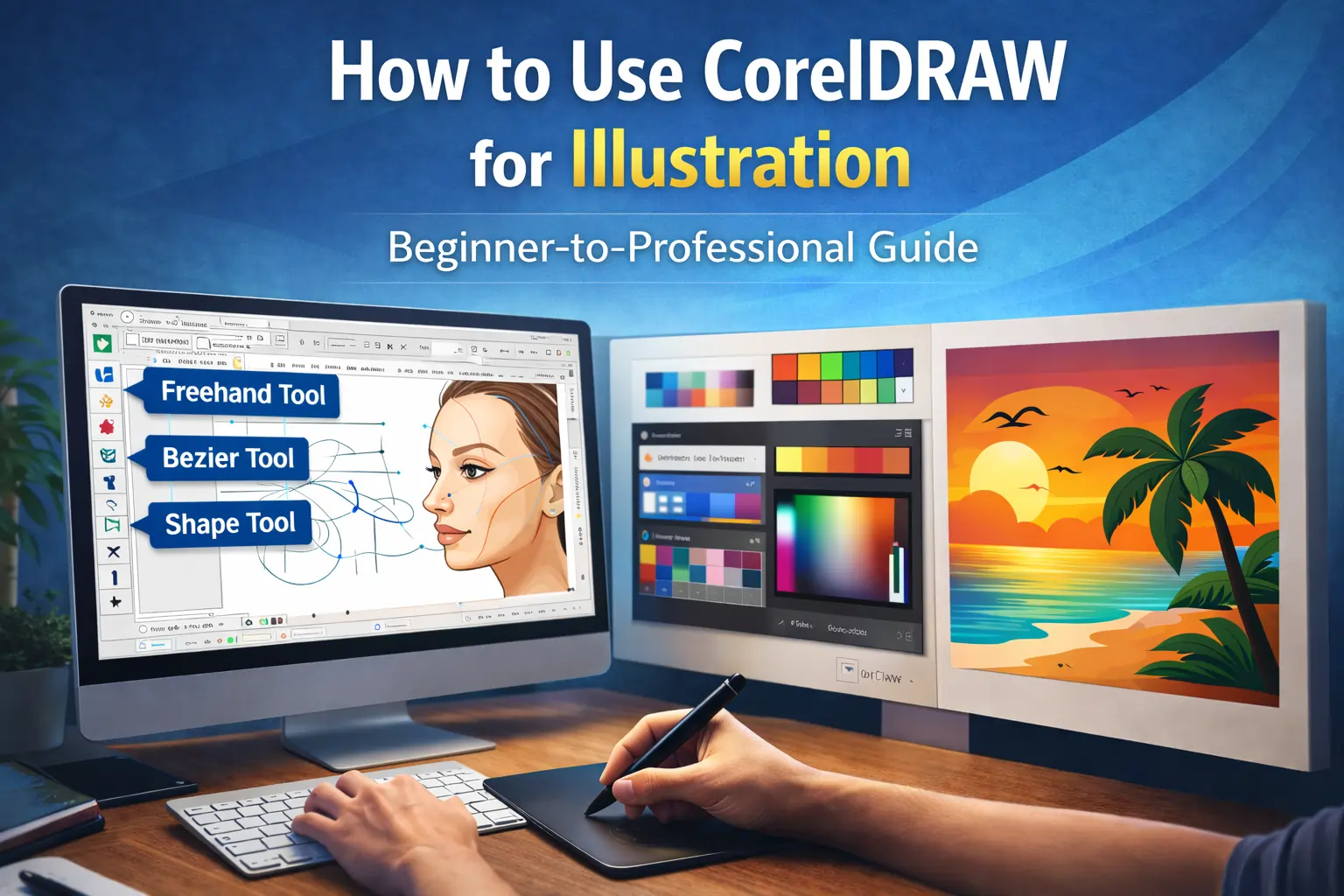
A Complete Beginner-to-Professional Guide for Vector Illustration and Digital Artwork
Why CorelDRAW Is a Powerful Tool for Illustration
Illustration is not just about drawing shapes- it is about storytelling, precision, scalability, and visual consistency. Choosing the right software plays a critical role in how efficiently and professionally an illustrator can work. This is where CorelDRAW stands out.
While CorelDRAW is often associated with logo and print design, it is equally powerful for vector illustration. From character design and icons to commercial artwork and digital illustrations, CorelDRAW offers the control and flexibility that illustrators need.
In this guide, you will learn How to use CorelDRAW for illustration, whether you are a beginner just starting out or a professional illustrator looking to refine your workflow.
🔥 LinkedIn Premium Business Plan 12 Months
Original Price ₹23,000 • Get it ₹8XXX
🤖 Gemini AI Advanced Pro Plan
Original Price ₹19,500 • Get it ₹8XXX
💼 LinkedIn Sales Navigator Core
Original Price ₹80,000 • Get it ₹2XXXX
🎨 Canva Pro Lifetime Access
Original Price ₹3,999 • Get it ₹4XX
📚 Coursera Plus Annual Plan
Original Price ₹33,000 • Get it ₹2XXX
✨ Adobe Creative Cloud All Apps
Original Price ₹59,000 • Get it ₹4XXX
What Makes CorelDRAW Suitable for Illustration
Illustration software must be flexible, precise, and scalable. CorelDRAW excels in all three areas.
The biggest advantage is its vector-based workflow. Vector illustrations do not lose quality when resized, making them ideal for everything from small icons to large-format prints. This is essential for illustrators working across multiple platforms.
Another key strength is node-level control. CorelDRAW allows deep customization of curves, shapes, and paths, which is crucial for creating expressive and detailed illustrations.
Understanding Vector Illustration Before You Begin
Before working in CorelDRAW, it is important to understand what vector illustration actually means.
Vector illustrations are created using paths and mathematical curves rather than pixels. This allows artwork to remain sharp, editable, and lightweight. Key benefits include:
-
Resolution-independent scaling
-
Clean and precise edges
-
Easy color editing
-
Print and digital compatibility
CorelDRAW is built specifically for vector illustration, which makes it a strong choice for illustrators at any level.
🔥 LinkedIn Premium Business Plan 12 Months
Original Price ₹23,000 • Get it ₹8XXX
🤖 Gemini AI Advanced Pro Plan
Original Price ₹19,500 • Get it ₹8XXX
💼 LinkedIn Sales Navigator Core
Original Price ₹80,000 • Get it ₹2XXXX
🎨 Canva Pro Lifetime Access
Original Price ₹3,999 • Get it ₹4XX
📚 Coursera Plus Annual Plan
Original Price ₹33,000 • Get it ₹2XXX
✨ Adobe Creative Cloud All Apps
Original Price ₹59,000 • Get it ₹4XXX
CorelDRAW Interface Explained for Illustrators
The Toolbox – Your Primary Drawing Area
The Toolbox on the left side contains all essential illustration tools, including freehand drawing, Bézier curves, shape editing, and artistic media tools. Most illustration work starts here.
Property Bar – Context-Sensitive Controls
The Property Bar changes based on the selected object or tool. This speeds up illustration work by providing immediate access to relevant options like stroke width, node smoothing, and alignment.
How to Use CorelDRAW for Illustration as a Beginner
One of the most common beginner mistakes is trying to create complex illustrations too early. The correct approach is to start simple.
Begin by practicing:
-
Drawing basic shapes
-
Combining shapes into objects
-
Editing curves and nodes
-
Applying flat colors
Once you gain control over shapes and curves, illustration becomes far more intuitive and creative.
🔥 LinkedIn Premium Business Plan 12 Months
Original Price ₹23,000 • Get it ₹8XXX
🤖 Gemini AI Advanced Pro Plan
Original Price ₹19,500 • Get it ₹8XXX
💼 LinkedIn Sales Navigator Core
Original Price ₹80,000 • Get it ₹2XXXX
🎨 Canva Pro Lifetime Access
Original Price ₹3,999 • Get it ₹4XX
📚 Coursera Plus Annual Plan
Original Price ₹33,000 • Get it ₹2XXX
✨ Adobe Creative Cloud All Apps
Original Price ₹59,000 • Get it ₹4XXX
Drawing Techniques in CorelDRAW – Freehand vs Bézier Tool
CorelDRAW offers multiple ways to draw, but two tools are most important for illustration.
The Freehand Tool is useful for rough sketches and organic shapes. It mimics natural drawing and is great for concept art.
The Bézier Tool provides precision and control. Professional illustrators rely heavily on this tool for clean, scalable artwork. Most high-quality vector illustrations are created using the Bézier Tool combined with node editing.
Mastering the Shape Tool (Most Important Tool for Illustration)
The Shape Tool is the heart of vector illustration in CorelDRAW.
With this tool, you can:
-
Smooth or sharpen curves
-
Adjust node positions
-
Create organic shapes
-
Refine line quality
Illustration quality depends more on control than complexity, and the Shape Tool provides that control.
Creating Vector Illustrations Using Basic Shapes
Professional illustrators rarely draw everything from scratch. Instead, they build illustrations by combining simple shapes.
For example:
-
Circles can form faces and eyes
-
Rectangles can form bodies and structures
-
Curves define expressions, hair, and motion
Using CorelDRAW’s Weld, Trim, and Intersect tools, these shapes can be merged into clean, complex illustrations.
Using Colors, Fills, and Gradients in Illustration
Color defines the mood and clarity of an illustration. CorelDRAW offers advanced color management tools that help illustrators maintain consistency.
Flat colors are ideal for modern illustrations, while gradients and transparency can add depth when used carefully. Professional illustrators often create limited color palettes to maintain visual harmony across projects.
Artistic Media Tool – Creating a Hand-Drawn Look
The Artistic Media Tool allows illustrators to create brush strokes, textured lines, and calligraphic effects while remaining in vector format.
This tool is especially useful for:
-
Sketch-style illustrations
-
Ink and comic artwork
-
Expressive line art
It bridges the gap between traditional drawing and digital vector illustration.
Managing Layers for Complex Illustrations
As illustrations grow more detailed, proper layer management becomes essential.
Using the Object Manager docker, you can separate backgrounds, characters, and details into layers. This makes editing easier and prevents accidental changes.
Professional illustrators rely on structured layers to manage complex artwork efficiently.
How to Use CorelDRAW for Character Illustration
Character illustration requires consistency, expression, and adaptability. CorelDRAW supports this through reusable shapes and symbols.
Illustrators often create base character components and modify them for different poses or expressions. This approach saves time and ensures design consistency, especially in branding and storytelling projects.
Exporting Illustrations for Print and Digital Use
An illustration is only complete when it is exported correctly.
CorelDRAW supports multiple formats, including:
-
SVG for web and UI design
-
PNG for transparent digital artwork
-
PDF for print and client delivery
Choosing the correct export settings ensures your illustration looks professional on every platform.
Common Mistakes Illustrators Make in CorelDRAW
Many beginners struggle due to a few common mistakes:
-
Using too many colors
-
Creating unnecessary nodes
-
Ignoring layer organization
-
Relying on raster images
Avoiding these mistakes significantly improves illustration quality.
How to Use CorelDRAW for Illustration Effectively (Professional Mindset)
Using CorelDRAW effectively is less about tools and more about workflow.
Professional illustrators:
-
Work with references
-
Keep vector paths clean
-
Reuse design elements
-
Maintain consistency
CorelDRAW supports this mindset when used strategically.
Is CorelDRAW Still Good for Illustration Today?
Yes, CorelDRAW remains a strong choice for illustration, especially for vector-based, print-ready, and commercial artwork.
It is particularly effective for illustrators who need scalability, precision, and professional output across digital and print platforms.
Final Verdict – How to Use CorelDRAW for Illustration
CorelDRAW is an underrated but highly capable illustration tool. It offers beginners an accessible entry point and professionals the control they need for advanced vector artwork.
Final Thought
If you are serious about illustration as a skill or profession, learning how to use CorelDRAW for illustration is a smart long-term investment. Master the tools, develop a clean workflow, and your creative potential will scale naturally.
FAQs: How to Use CorelDRAW for Illustration
Q1. Is CorelDRAW good for illustration?
Yes, CorelDRAW is a strong tool for vector illustration. It is especially effective for creating scalable artwork such as icons, characters, line art, and commercial illustrations that need to work across print and digital platforms.
Q2. Can beginners use CorelDRAW for illustration?
Absolutely. CorelDRAW is beginner-friendly if you start with basic shapes, curves, and node editing. Its logical interface and vector-based workflow make it easier for beginners compared to complex raster-based tools.
Q3. What type of illustrations can be created in CorelDRAW?
With CorelDRAW, you can create:
-
Vector illustrations
-
Character illustrations
-
Icons and symbols
-
Line art and flat illustrations
-
Print-ready and commercial artwork
It is best suited for clean, scalable illustration styles.
Q4. Is CorelDRAW better than Photoshop for illustration?
CorelDRAW and Photoshop serve different purposes. CorelDRAW is better for vector illustration that needs scalability and precision, while Photoshop is more suitable for raster-based digital painting and photo manipulation.
Q5. Which CorelDRAW tools are most important for illustration?
The most important tools for illustration in CorelDRAW are:
-
Bézier Tool for precise drawing
-
Shape Tool for node editing
-
Artistic Media Tool for brush effects
-
Weld, Trim, and Intersect for shape creation
Mastering these tools covers most illustration needs.
Q6. Can CorelDRAW illustrations be used for print and digital both?
Yes. CorelDRAW illustrations can be exported for both print and digital use. You can export SVG for web, PNG for digital artwork, and PDF for high-quality print output without losing quality.
Q7. Is CorelDRAW suitable for professional illustrators?
Yes, many professional illustrators use CorelDRAW for commercial illustration, branding assets, and print-based projects. Its precision, color control, and export flexibility make it suitable for professional workflows.
Q8. How long does it take to learn CorelDRAW for illustration?
Basic illustration skills can be learned within a few weeks of regular practice. Mastery depends on understanding vector concepts, node control, and developing a consistent illustration workflow rather than just learning tools.
Q9. Can I create hand-drawn style illustrations in CorelDRAW?
Yes. Using the Artistic Media Tool and custom brushes, you can create hand-drawn, sketch-style, and ink-based illustrations while keeping them fully vector and editable.
Q10. Is CorelDRAW still relevant for illustration in 2026 and beyond?
Yes. CorelDRAW remains relevant, especially for vector illustration, print design, and commercial artwork. Its continuous updates and strong vector engine keep it competitive for professional illustrators.